
Start your One-Week Free Trial
Already subscribed? Log in »


Pharyngeal Muscles
Here we’ll learn the muscles that comprise the pharynx, aka, the throat; recall that the pharynx is the common pathway for foods, liquids, and air.
The pharynx is a half-cylinder musculofascial structure that attaches to the base of the skull and is continuous with the esophagus (at approximately level CVI). It opens to the oral and nasal cavities superiorly, and connects them to the larynx and esophagus, inferiorly.
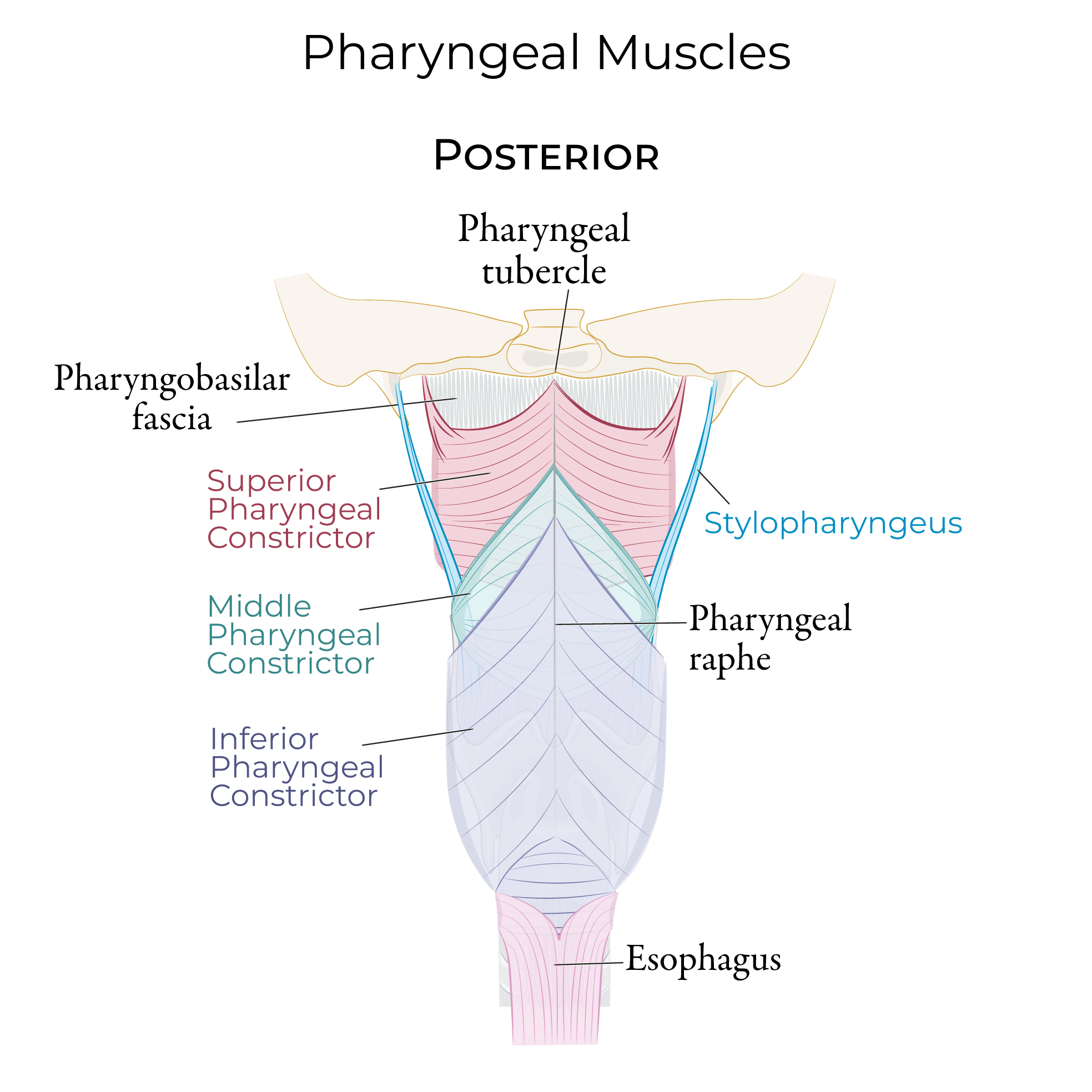
Let’s set up our first diagram, which will show the superficial muscles in posterior view.
We’ll primarily be able to see the constrictor muscles in this view, which have a circular orientation.
Now, let’s “open up” the pharynx to show these muscles from the inside-out, which will allow us to show the remaining longitudinal muscles.
The longitudinal muscles elevate the pharynx during swallowing.
First, we re-draw the base of the skull, hyoid, larynx with epiglottis, and the trachea.
Now, on only one side of the diagram, we show stylopharyngeus and the constrictors: superior, middle, and inferior.
For context, show the tongue in front of the epiglottis, and indicate the esophagus at the end of the pharynx.
On the other side of the skull, we’ll show these muscles as if we’ve cut along the pharyngeal raphe and pulled the muscles away from the midline.
Start inferiorly and show the inferior and middle pharyngeal constrictors pulled away from the midline.
Then, we show stylopharyngeus as it arises from the medial aspect of the styloid process and travels inferiorly to the posterior border of the thyroid cartilage and blends in with the pharyngeal constrictors.
Stylopharyngeus is innervated by the glossopharyngeal nerve (CN IX).
Now, we show the superior pharyngeal constrictor and the pharyngobasilar fascia pulled away from the midline; notice that this sandwiches the stylopharyngeus muscle between the superior and middle constrictors.
This is an external view of the pharynx.
This is an internal view of the pharynx, as if we've dissected the head and neck along the midline.
Posterior View - Superficial
Key Landmarks
The base of the skull, hyoid, larynx, and trachea; pharyngeal tubercle of the occipital bone.
The pharyngeal raphe, a cord-like ligament, extends inferiorly and merges with the connective tissue of the esophagus.
We’ll show that the pharyngeal constrictors come together at this midline raphe.
Stylopharyngeus
One of the three longitudinal muscles, stylopharyngeus is a long cylindrical muscle that originates from the medial aspect of the styloid process and, as we’ll see, descends between the superior and middle constrictor muscles to blend in with the deep surface of the pharyngeal wall.
Stylopharyngeus is innervated by the glossopharyngeal nerve (CN IX).
Now, we’re ready to show the three constrictor muscles; these muscles are named for their relative location: superior, middle, inferior. As we’ll show, they overlap like stacked mugs.
Pharyngobasilar fascia
Strong internal pharyngeal lining.
Superior constrictor muscle
Several points of anterior points of origin: the pterygomandibular raphe, adjacent bone on mandible, and the pterygoid hamulus. Its fibers fan posteriorly to meet at the pharyngeal raphe.
The space between the superior pharyngeal constrictor and the base of the skull is covered by the pharyngobasilar fascia (pharyngo = pharynx, basilar = a part of the occipital bone).
Notice that stylopharyngeus runs superficial to the superior pharyngeal constrictor.
Middle pharyngeal constrictor
Overlies portions of stylopharyngeus and the superior pharyngeal constrictor.
The middle pharyngeal constrictor arises from the greater horn of the hyoid bone and the adjacent margins of the lesser horn, and from the stylohyoid ligament.
Its fibers fan posteriorly to insert along the pharyngeal raphe.
Inferior pharyngeal muscle
Anteriorly, it arises from oblique line of the thyroid cartilage, the cricoid cartilage, and the ligament that spans between these attachments.
Its fibers fan posteriorly to insert along the pharyngeal raphe; show that inferior fibers also blend into wall of esophagus, which creates the seamless connection between these two segments.
Fascia
Fascia reinforces the pharyngeal wall, which is especially important where the irregularly shaped muscles do not completely overlap laterally.
Gaps
Gaps allow neurovascular structures and small muscles (ie, stylopharyngeus, which we’ve shown) to pass through the pharynx to anterior structures such as the larynx. You can learn more about these gaps and the structures that pass through them in our notes.
Innervation & Actions
The constrictors are innervated by the vagus nerve (CN X); during swallowing, they contract sequentially from top to bottom, which moves a bolus of food inferiorly through the pharynx to the esophagus (see our notes for more information on swallowing).
Posterior View - Deep
Choana
The opening between the nasal cavity and the nasopharynx; the vomer bone separates the right and left choanae. (more images in the notes).
Pharyngotympanic tube
Lateral to the choana, we see the pharyngotympanic (aka, auditory or Eustachian) tube – this tube connects the middle ear to the nasopharynx; we show it piercing the pharyngobasilar fascia.
Levator veli palatini muscle
Inferior to the choana, we see the levator veli palatini muscle as it passes inferiorly from the cartilage of the pharyngotympanic tube and the petrous portion of the temporal bone (not shown) to the midline palatine aponeurosis.
As its name suggests, this muscle elevates the soft palate, closing off entry to the nasopharynx during swallowing.
It is not a muscle of the pharyngeal wall, but we’ve drawn it so that we can show the next muscle: palatopharyngeus.
Palatopharyngeus
Palatopharyngeus is also a muscle of the soft palate; it attaches to the upper surface of the palatine aponeurosis and passes posteriorly and inferiorly to blend with deep surface of pharyngeal wall.
It is innervated by CN X via the pharyngeal plexus (which itself comprises fibers from CN IX and X, and sympathetic fibers from the cervical ganglion).
Salpingopharyngeus. “
Salpinx” means tube – salpingopharyngeus originates on the inferior aspect of the pharyngotympanic tube and descends to blend in with the palatopharyngeus muscle. It is innervated by CN X.
Tonsils
Pharyngeal tonsil in the roof of the nasopharynx.
Palatine tonsils in the wall of the lateral oropharynx (the palatine tonsils are also called the faucil tonsils because they are in the fauces, which is the narrow passage between the soft palate and the base of the tongue).
Lateral View
Key Landmarks
Lateral side of the skull; label the styloid process. We include the mandible and teeth for context.
Hyoid bone, larynx, and trachea; we show the thyrohyoid membrane between the thyroid cartilage and hyoid bone.
The pharyngeal raphe extends inferiorly from the pharyngeal tubercle.
The pterygomandibular raphe is a thin tendinous band that extends from the medial pterygoid plate to the mandible.
The stylohyoid ligament extends from styloid process to the hyoid bone.
The oblique line of the thyroid cartilage.
Superior pharyngeal constrictor
In lateral view we can see its attachments to the pterygomandibular raphe and the adjacent bone on mandible, and that its fibers extend posteriorly to insert along the pharyngeal raphe.
Stylopharyngeus
Arises from the styloid process and extends inferiorly.
Middle pharyngeal constrictor
Arises from the hyoid bone and the stylohyoid ligament and fans posteriorly to wrap over stylopharyngeus and the inferior portion of the superior pharyngeal constrictor and insert on the pharyngeal raphe.
Inferior pharyngeal constrictor
Arises from the oblique line of the thyroid cartilage and the cricoid cartilage and wraps posteriorly over the bottom portion of the middle pharyngeal constrictor. Its inferior fibers blend with the esophagus.
Gaps between constrictors
In this view we can highlight key gaps between the constrictor muscles:
The gap between the superior and middle pharyngeal constrictors allows stylopharyngeus, the glossopharyngeal nerve, and stylohyoid ligament to pass through pharyngeal wall to reach the internal pharynx.
The gap between the middle and inferior pharyngeal constrictors allows the internal laryngeal nerve and superior laryngeal artery and vein to pass to the larynx (we show where neurovascular structures pierce the thyrohyoid membrane).
The gap inferior to the inferior constrictor allows the recurrent laryngeal nerve and the inferior laryngeal artery to pass into the larynx.
Medial View
Key landmarks
The skull, hyoid, and larynx.
The hard palate and soft palate (the soft palate comprises muscles and palatine aponeurosis).
Cartilage of the pharyngotympanic tube (aka, auditory or Eustachian tube).
Pharyngeal raphe, pterygomandibular raphe and stylohyoid ligament.
Now, we can show all three longitudinal muscles.
Stylopharyngeus
Palatopharyngeus
Attaches to the palatine aponeurosis and soft palate and passes posteriorly and inferiorly to blend with deep surface of pharyngeal wall.
Salpingopharyngeus
Originates on the inferior aspect of pharyngotympanic tube and descends to blend in with the pharyngeal wall. It's helpful to know that "salpinx" means tube, and this muscle attaches to the pharyngotympanic tube.
Pharyngeal Constrictors
Superior, Middle, and Inferior
The inferior muscle is the most superficial, the superior constrictor is the deepest.
Also notice that we can see where stylopharyngeus threads between the superior and middle constrictors to pass from the styloid process to the internal pharynx.
During swallowing, the 3 pharyngeal constrictors contract sequentially from top to bottom, transferring a bolus of food inferiorly through the pharynx to the esophagus; the longitudinal muscles move the pharynx up and over the bolus.