Start your One-Week Free Trial
Already subscribed? Log in »
Pharyngeal Blood Supply
Pharyngeal Blood Supply
Set up diagram in lateral view
Set up the diagram with the same bony, cartilaginous, and muscular features as our previous diagram.
Show the subclavian artery, and indicate that it gives rise to the common carotid artery and the thyrocervical trunk.
The thyrocervical trunk gives rise to the inferior thyroid artery and the pharyngeal branches. These arteries supply the lower pharynx.
Now, to show blood supply to the upper pharynx, show the common carotid artery splitting into internal and external branches.
Key Branches of the External Carotid Artery
The ascending pharyngeal artery, which originates just after the common carotid artery bifurcates and gives rise to an anterior pharyngeal division and a posterior neuromeningeal division.
The lingual artery, which passes over the middle pharyngeal constrictor on its way to the tongue.
The facial artery gives rise to the tonsillar branch, which pierces the superior constrictor to reach the palatine tonsil, and the ascending palatine artery, which serves the soft palate.
The external carotid artery terminates where it splits into the superficial temporal artery and the maxillary artery.
Within the skull, the maxillary artery travels with the maxillary nerve.
The maxillary artery gives rise to the pharyngeal branch, which serves the mucosa of the nasopharynx, pharyngotympanic tube, and the sphenoid sinus.
Carotid Artery Review
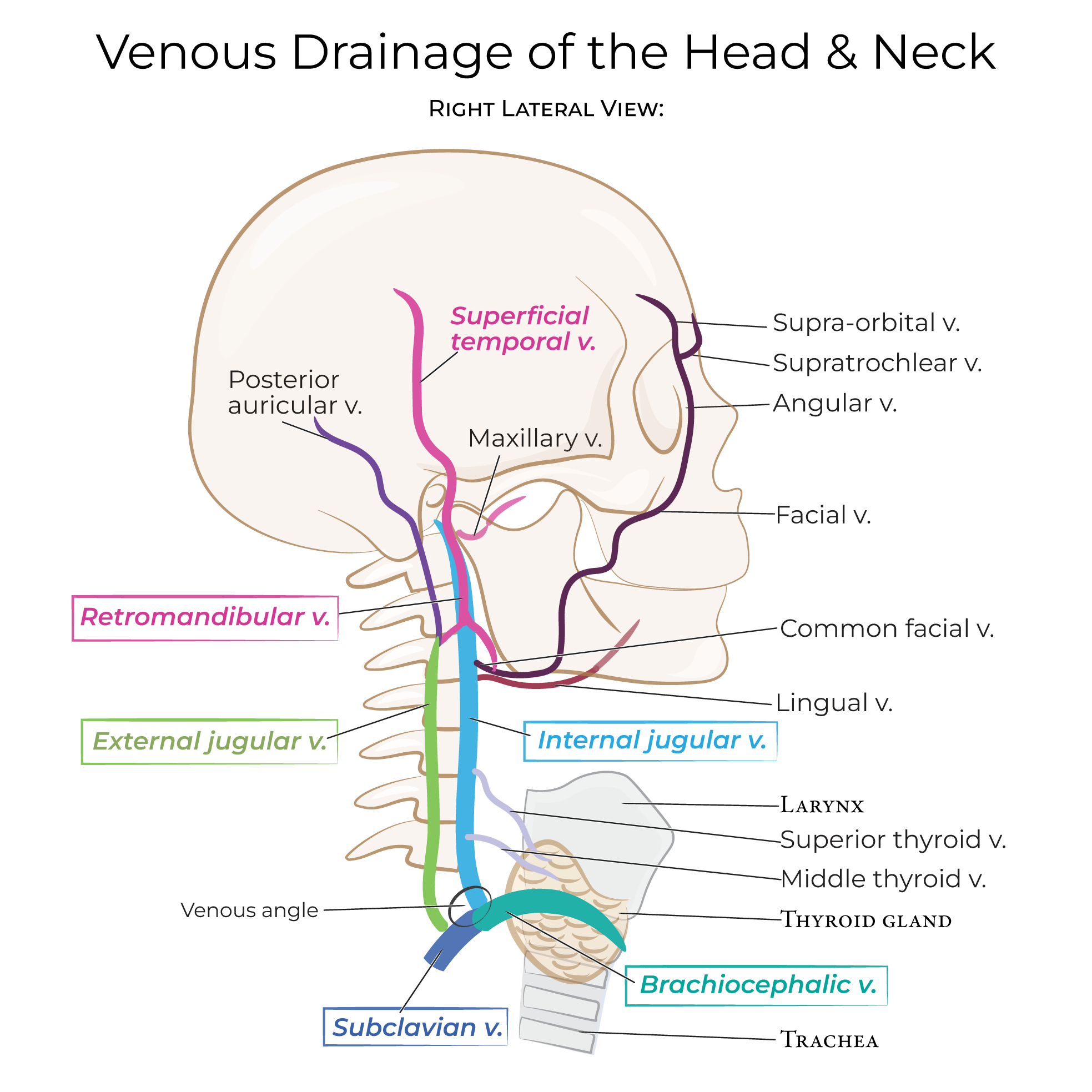
Venous Drainage
Venous drainage occurs via the venous plexus. Inferiorly, the venous plexus drains into the facial and internal jugular veins; superiorly, it drains into the pterygoid plexus in the infratemporal fossa.