

Start your One-Week Free Trial
Already subscribed? Log in »
Pharyngeal Innervation
Motor & Sensory Innervation
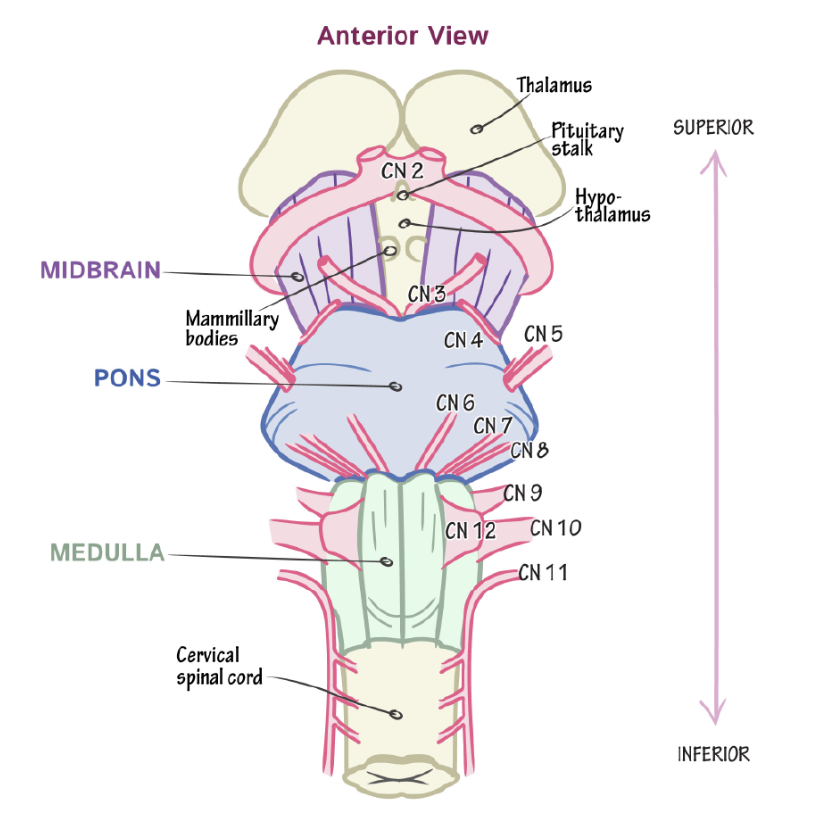
Nerves
Maxillary nerve (V2 of CN V) – gives rise to a pharyngeal branch deep within the pterygopalatine fossa. This branch passes through the palatovaginal canal in the sphenoid bone to provide sensory innervation to the nasopharynx.
Glossopharyngeal nerve exits the skull through the jugular foramen and travels along the posterior aspect of stylopharyngeus; it passes through the gap between the superior and middle pharyngeal constrictors on its way to the tongue.
Vagus nerve exits the skull through the jugular foramen and forms the inferior ganglion.
The pharyngeal branch of the vagus nerve provides motor control to many muscles of the soft palate and pharynx; the pharyngeal branch also carries sensory and parasympathetic information to the plexus.
The superior laryngeal nerve arises from the vagus nerve Inferior to the pharyngeal branch; it gives rise to an internal branch, which passes through the thyrohyoid membrane, and an external branch, which continues along the inferior pharyngeal constrictor.
In sum, we can see that the vagus nerve (CN X) provides motor stimulation to all muscles of pharynx except for stylopharyngeus, which is innervated by glossopharyngeal nerve (CN IX).
Sensory Innervation
Pharyngeal sensory innervation is organized by region:
The nasopharynx is innervated by the maxillary nerve.
The oropharynx is innervated by the glossopharyngeal nerve (which is why CN IX is the afferent limb of the gag reflex).
The laryngopharynx is innervated by the vagus nerve.