Introduction to Gastrointestinal Physiology
Key processes that occur in the gastrointestinal system:
- Ingestion of food and water brings substances into the GI tract via the mouth.
- Propulsion of substances through the GI tract – as we'll see, this includes swallowing and peristalsis.
- Mechanical breakdown physically prepares food for digestion and increases its surface area for interactions with digestive juices; mechanical breakdown includes chewing, mixing foods with saliva, churning in the stomach, and segmentation in the small intestine.
- Digestion is the enzymatic breakdown of food into its chemical building blocks.
- Absorption occurs when the digested end products pass from the lumen of the digestive tract to the blood and lymph systems.
- Defecation, which eliminates indigestible wastes from the body as feces.
In the simplest terms, the gastrointestinal system comprises a long tube, aka, a tract, which food and liquids pass through, and accessory organs that aid in digestion.
The GI tract, aka, alimentary canal, is a continuous muscular tube that is open at the mouth and anus; foods and liquids are held within the tube.
Mucus is secreted throughout the GI tract to soften and moisten food for digestion and to lubricate the food for easier passage through the tract.
Accessory organs, such as the gallbladder, pancreas, and salivary glands aid in digestion.
Sphincters are muscular rings that act as one-way valves; examples include the upper and lower esophageal sphincters, which regulate entry into and out of the esophagus, and the pyloric sphincter, which regulates the passage of stomach contents into the small intestines.
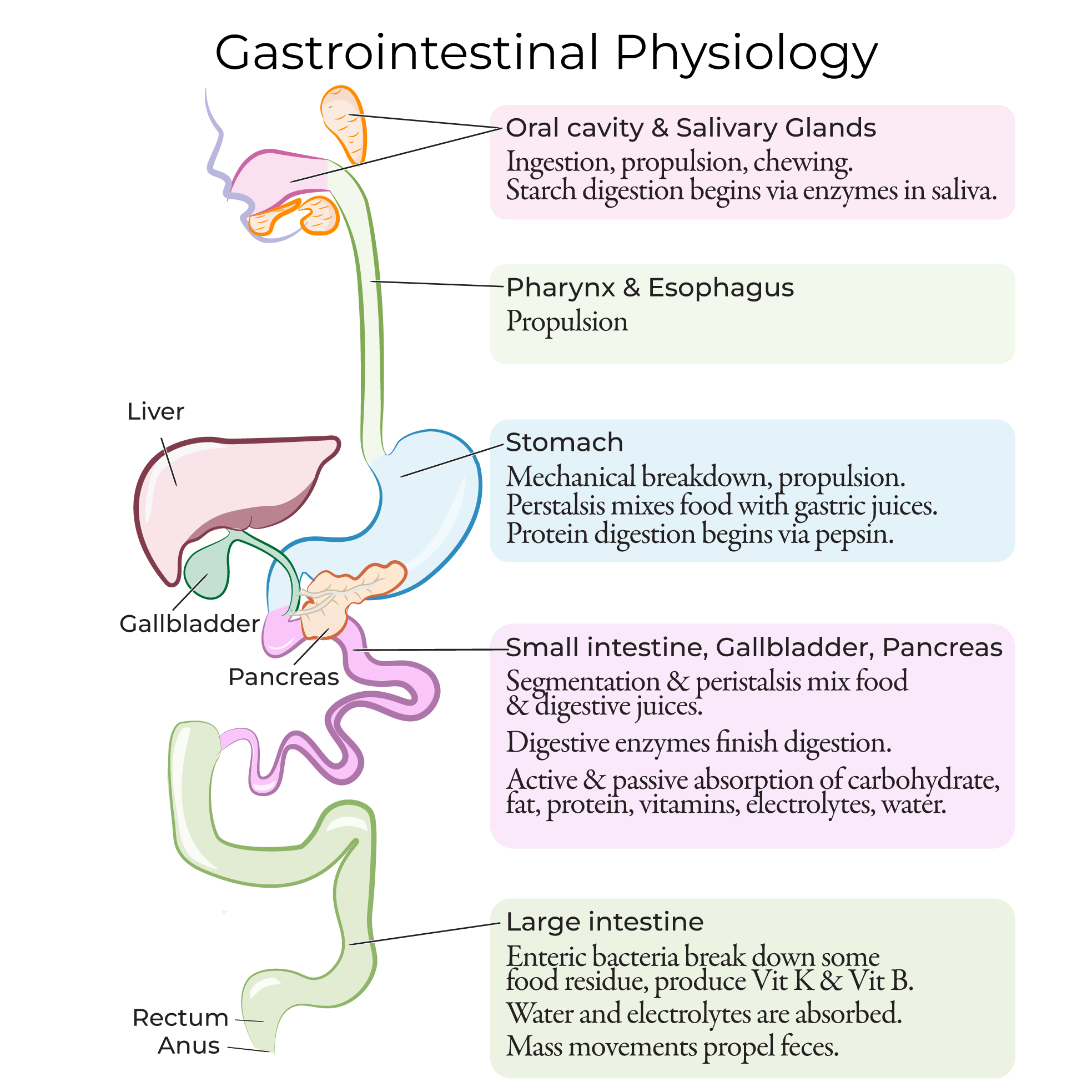
Oral Cavity: First, food enters the GI tract begins via the oral cavity (the mouth), which receives saliva from the nearby salivary glands.
Pharynx & Esophagus: Upon swallowing, food is pushed into the pharynx (the throat) and then to the esophagus.
Stomach & Intestines: From the esophagus, food enters the stomach, then passes through the small and large intestines. The
large intestine concludes with the rectum and anus.
Accessory organs secrete digestive juices into the small intestine:
- The liver, which creates bile.
- The gallbladder, which stores bile.
- The pancreas, which creates pancreatic enzymes.
Though it varies by person and type of food, it takes 1-3 days for food to pass through the entire GI tract.
Now, return to the top of the diagram and fill in the physiologic details.
Chewing & Carbohydrate Breakdown: In the oral cavity, ingestion, propulsion, and mechanical breakdown via chewing take place; salivary enzymes begin the process of starch digestion.
Propulsion: The pharynx and esophagus propel food towards the stomach via alternating waves of muscular contraction and relaxation.
Mechanical & Chemical Breakdown: In the stomach, mechanical breakdown and propulsion continue; peristalsis mixes food with gastric juices, and pepsin begins the process of protein digestion.
Absorption: In the small intestine specialized, coordinated muscular contractions called segmentation and peristalsis mix food with digestive juices from the pancreas and gallbladder.
- Digestion is completed in the small intestine via pancreatic and brush border enzymes, and, that active and passive absorption of carbohydrate, fat, protein, vitamins, electrolytes, and water occurs.
Vitamin Production & Elimination: Lastly, in the large intestine, enteric bacteria break down some food residues and produce the vitamins K and B; mass movements propel feces for elimination.
Let's sketch a representative section of the GI tract in cross section to show its four layers.
From outer to inner:
The adventitia or serosa, which is a protective covering; as a general rule, a segment of the digestive tract that can move freely is covered by serosa, and a segment that is rigidly fixed is covered by adventitia.
The muscularis externa, which is the layer of smooth muscle that contracts to move food through the GI tract. Generally, this layer comprises two sublayers, one circular and one longitudinal, which helps to "squeeze" the food from different directions.
The submucosa, which comprises glands, blood vessels, nerves, and lymphatic tissues that serve the GI tract.
Mucosa, which is lined by epithelia and is in direct contact with the contents of the GI tract; this layer also secretes mucus, which, as we mentioned earlier, moistens foods and lubricates the GI tract for easier passage.
Lumen, which is the space enclosed by these four layers, aka, tunics; this is the space that food and liquids occupy.
See
histological samples