
USMLE/COMLEX 1 - Hypoparathyroidism & Calcium Imbalances
Start your One-Week Free Trial
Already subscribed? Log in »
Here are key facts for USMLE Step 1 & COMLEX-USA Level 1 from the Parathyroid Hormone & Calcium Homeostasis tutorial, as well as points of interest at the end of this document that are not directly addressed in this tutorial but should help you prepare for the boards. See the tutorial notes for further details and relevant links.
 Below is information not explicitly contained within the tutorial but important for USMLE & COMLEX 1.
- --
VITAL FOR USMLE/COMLEX 1
Parathyroid Hormone Basics
1. Parathyroid hormone increases ECF calcium levels.
2. Regulated by calcium and vitamin D.
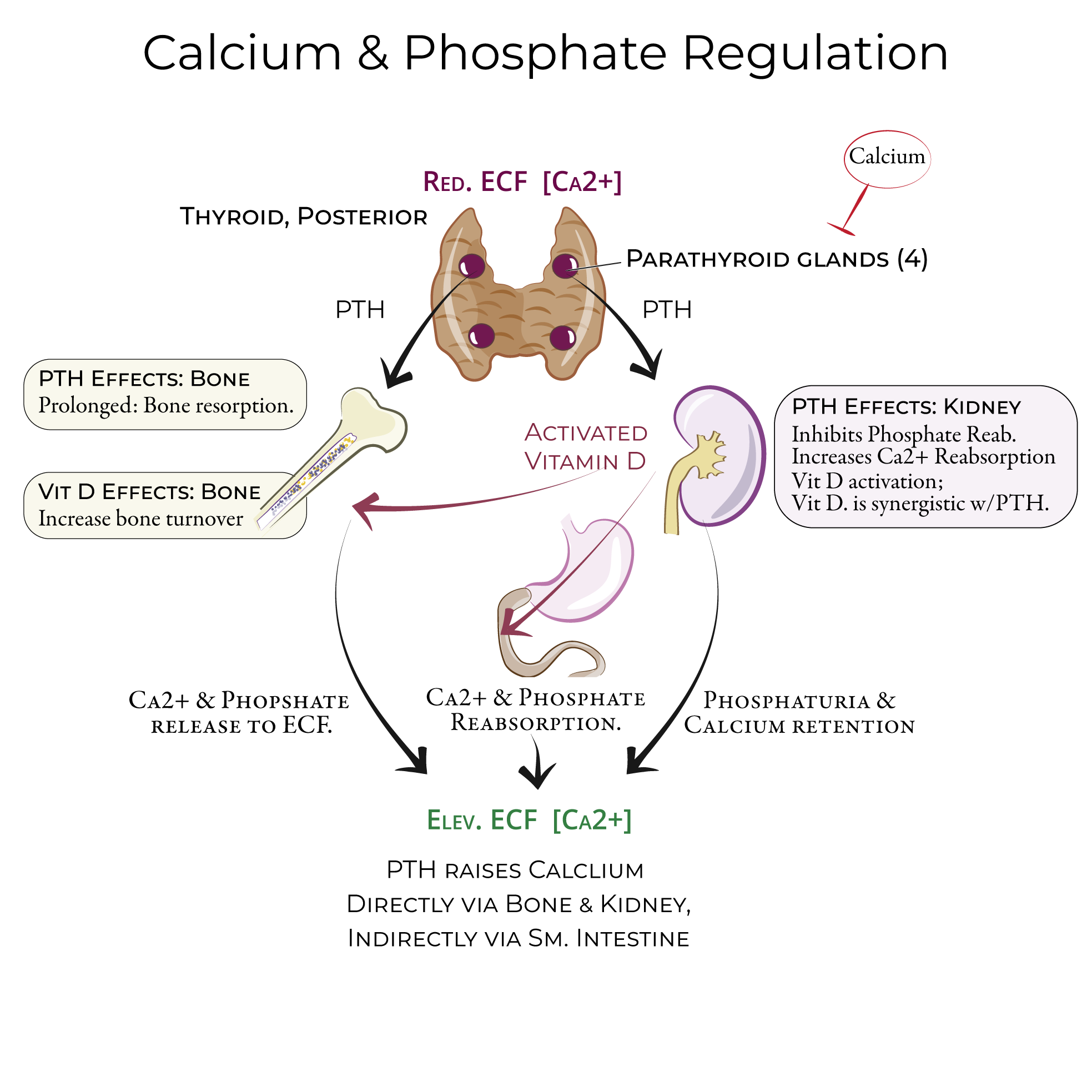
3. Parathyroid hormone protects against hypocalcemia by causing calcium release from the bones and reabsorption from the kidneys.
4. Typical reference blood calcium range is 2.2-2.6 mmol/L (8.6-10.3 mg/dL).
5. Parathyroid gland location: posterior aspect of the thyroid gland.
PTH Physiology
1. In response to reduced extracellular calcium concentration, the parathyroid glands secrete parathyroid hormone (PTH).
2. Prolonged exposure to parathyroid hormone promotes resorption of old bone, and, therefore, the release of calcium and phosphate into extracellular fluid.
3. Episodic, transient binding of parathyroid hormone causes an increase in new bone synthesis.
4. If Vitamin D levels are high, parathyroid hormone secretion is inhibited.
Hypoparathyroidism
1. Most often the result of surgical removal or damage to the parathyroid glands.
2. Other causes include autoimmune destruction (i.e., Autoimmune polyglandular syndrome type 1), congenital lack of functioning parathyroid glands, and very low magnesium levels.
3. Low parathyroid hormone leads to low levels of calcium and high levels of phosphate.
4. Two key signs of tetany in hypoparathyroidism: Chvostek sign and Trousseau's sign.
5. Chvostek sign: tapping the facial nerve produces facial muscle spasms.
6. Trousseau's sign: carpopedal spasm seen after a few minutes of wearing an inflated blood pressure cuff (20 mmHg above systolic pressure).
- --
HIGH YIELD
PTH Effects on Target Organs
1. Bones: Prolonged exposure to parathyroid hormone promotes resorption of old bone, releasing calcium and phosphate into extracellular fluid.
2. Kidneys: Parathyroid hormone increases calcium reabsorption in the distal convoluted tubule of the nephrons.
3. Kidneys: PTH stimulates activation of Vitamin D (activated form = 1,25(OH)2-VD).
4. Vitamin D acts on the nephron to increase reabsorption of calcium and phosphate.
5. In the small intestine, Vitamin D increases calcium and phosphate reabsorption.
6. In the bones, Vitamin D works with parathyroid hormone to facilitate skeletal remodeling, which requires both synthesis and resorption of bone.
7. The total effect of parathyroid hormone is to elevate extracellular calcium levels.
Clinical Manifestations of Hypoparathyroidism
Neuromuscular Effects
1. Muscle weakness
2. Paresthesia (tingling or burning, especially in the feet, hands, and around the mouth)
3. Cramping
4. Tetany
5. Laryngospasms, bronchospasms, and stridor
Other System Effects
1. Psychiatric: Irritability and confusion.
2. Cardiovascular: Include prolonged QT interval or heart failure.
3. Ocular: Cataracts
Treatment Approaches
1. Activated Vitamin D and calcium supplements, possibly magnesium supplements.
2. Diets high in calcium (consume more green leafy vegetables, legumes, fortified cereals) and low in phosphorous (less meat, soft drinks, and dairy products, which are high in phosphorus).
Related Disorders
1. Pseudohypoparathyroidism: Patients present with signs and symptoms associated with hypoparathyroidism but normal or elevated levels of parathyroid hormone – these patients have hormone resistance in the target organs.
Calcium Imbalances - Additional Causes
Hypercalcemia
1. Disorders that cause excessive bone resorption: Cancers, Paget disease, hyperthyroidism, Familial hypocalciuric hypercalcemia, Vitamin D toxicity.
2. Disorders that cause excessive gastrointestinal calcium absorption: Sarcoidosis, other granulomatous diseases.
3. Drugs that increase extracellular calcium, including lithium and thiazide diuretics.
Hypocalcemia
1. Vitamin D deficiency or resistance (including antiseizure drugs that alter vitamin D metabolism)
2. Pancreatitis
3. Magnesium imbalances
- --
Beyond the Tutorial
Parathyroid Hormone Related Protein (PTHrP)
1. Structure similar to PTH; secreted by certain malignancies
2. Primary cause of humoral hypercalcemia of malignancy (HHM)
3. Acts on PTH receptors but has minimal effect on 1,25(OH)2D production
Secondary Hyperparathyroidism
1. Common in chronic kidney disease due to phosphate retention and decreased 1,25(OH)2D
2. Results in renal osteodystrophy
3. Can lead to calciphylaxis (vascular calcification with skin necrosis)
Parathyroid Disorders in Multiple Endocrine Neoplasia (MEN)
1. Primary hyperparathyroidism in MEN 1 (with pituitary and pancreatic tumors)
2. Primary hyperparathyroidism in MEN 2A (with medullary thyroid carcinoma and pheochromocytoma)
3. Genetic basis: MEN1 gene (menin) in MEN 1, RET proto-oncogene in MEN 2
Diagnostic Tests
1. Intact PTH assay distinguishes primary hyperparathyroidism (elevated) from hypercalcemia of malignancy (suppressed)
2. Parathyroid sestamibi scan for localizing adenomas
3. DEXA scan for evaluating bone mineral density in hyperparathyroidism