
USMLE/COMLEX 1 - GI Bleeding
Start your One-Week Free Trial
Already subscribed? Log in »
Here are key facts for USMLE Step 1 & COMLEX-USA Level 1 from the GI Bleeding tutorial, as well as points of interest at the end of this document that are not directly addressed in this tutorial but should help you prepare for the boards. See the tutorial notes for further details and relevant links.
- --
VITAL FOR USMLE/COMLEX 1
Basic Definitions
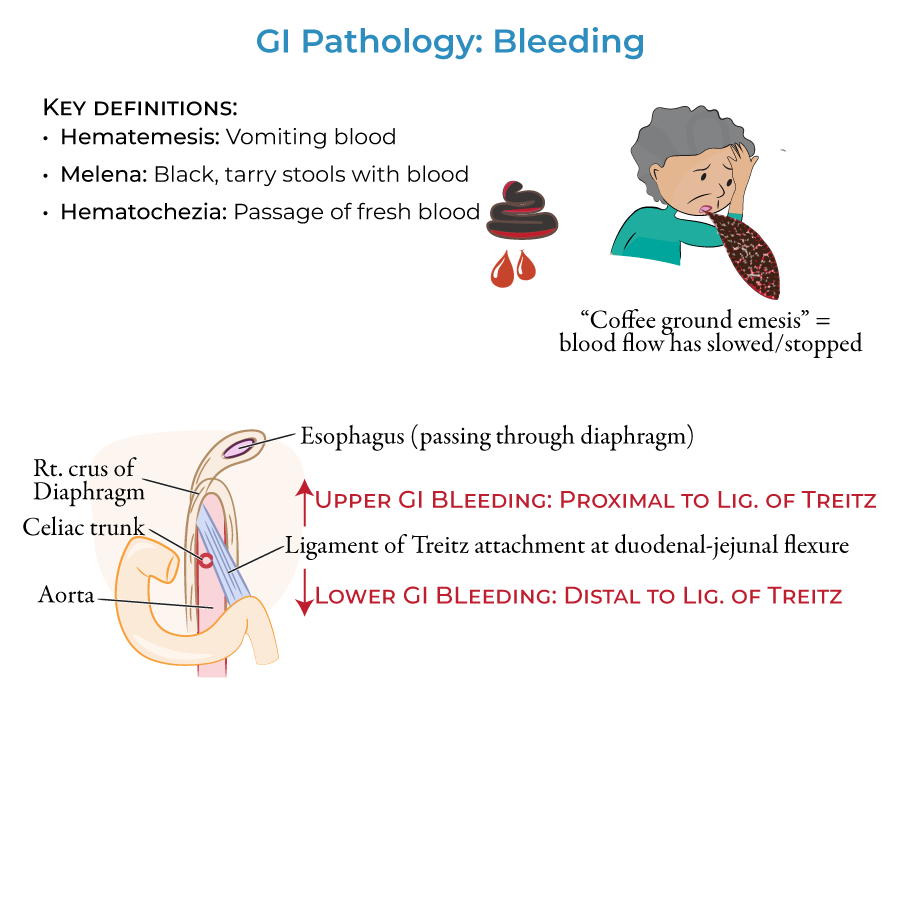
1. Hematemesis: Vomiting of blood ("heme" = blood; "emesis" = vomit).
2. Melena: Black, tarry stools with blood.
3. Hematochezia: Passage of bright red fresh blood.
4. Upper vs Lower GI tract: The dividing line is the ligament of Treitz (aka, the suspensory ligament of the duodenum).
Upper GI Bleeding Causes
1. Duodenal and gastric ulcers & erosion: Most common cause of upper GI bleeding, often resulting from H. pylori infection, drugs, stress, or autoimmune disorders.
2. Esophagitis: Inflammation causing erosion of the esophageal lining, commonly associated with acid reflux and alcohol consumption.
3. Varices: Enlarged veins in esophagus and proximal stomach that can rupture, associated with cirrhosis and portal hypertension.
4. Mallory-Weiss tears: Tears in distal esophagus resulting from violent vomiting or coughing.
Lower GI Bleeding Causes
1. Diverticular hemorrhage: Top cause of lower GI bleeding, characterized by brisk hematochezia with possibility of massive bleeding.
2. Inflammatory bowel disease: Particularly ulcerative colitis, causes bloody diarrhea when active.
3. Infectious colitis: Bacterial causes can produce fever, tenesmus, abdominal pain, and purulent, loose bloody stools.
4. Hemorrhoids: Swollen veins in rectum and perianal region that can rupture and cause hematochezia.
5. Anal fissures: Tears in anal sphincter producing bright, fresh blood with pain during and after bowel movements.
6. Acute and chronic intestinal ischemia: Causes lower GI bleeding along with nausea, vomiting, and abdominal pain.
Causes of Both Upper and Lower GI Bleeding
1. Neoplasms: Can occur anywhere along the GI tract and are often the presenting sign.
2. Vascular lesions: Including arteriovenous malformations, can cause bleeding throughout the GI tract.
- --
HIGH YIELD
Upper GI Bleeding Details
1. "Coffee ground" appearance of vomit indicates that blood flow has slowed or stopped.
2. Varices can cause potentially life-threatening hemorrhages and are directly linked to portal hypertension.
3. Mallory-Weiss tears are rare compared to other causes of upper GI bleeding.
Lower GI Bleeding Details
1. C. difficile infection is an important cause of infectious colitis following antibiotic use.
2. Viral colitis is associated with watery diarrhea, more common in infants and children.
3. Amoebic colitis is characterized by diarrhea and mucoid discharge.
4. Ulcerative colitis is characterized by mucosal and submucosal inflammation with sunken ulcers creating a friable appearance.
5. Diverticular hemorrhage shows diverticula in the colon wall with vascular rupture; diverticula are not necessarily inflamed when bleeding occurs.
Cross-Type Concepts
1. Bleeding patterns by location:
- Upper GI bleeding produces hematemesis and/or melena
- Lower GI bleeding produces melena and/or hematochezia
- --
Beyond the Tutorial
Diagnostic Workup
1. Endoscopy is the gold standard for evaluation of upper GI bleeding.
2. Colonoscopy is the primary diagnostic tool for lower GI bleeding.
3. Angiography can be useful for detecting active bleeding when endoscopy is inconclusive.
Risk Factors and Associations
1. NSAID use is strongly associated with gastric and duodenal ulcers.
2. Boerhaave syndrome: Full-thickness esophageal rupture from violent vomiting, differentiated from Mallory-Weiss tears.
3. Meckel's diverticulum: Important cause of lower GI bleeding in children, contains ectopic gastric mucosa.
Clinical Pearls
1. Amount of blood loss often correlates with hemodynamic stability - important for triage and management.
2. Nasogastric lavage can help localize bleeding to upper vs. lower GI tract.
3. Angiodysplasias are more common in elderly patients and those with aortic stenosis.