
USMLE/COMLEX 1 - Bacterial Endocarditis
Start your One-Week Free Trial
Already subscribed? Log in »
Here are key facts for USMLE Step 1 & COMLEX-USA Level 1 from the Bacterial Endocarditistutorial, as well as points of interest at the end of this document that are not directly addressed in this tutorial but should help you prepare for the boards.
 Below is information not explicitly contained within the tutorial but important for USMLE & COMLEX 1.
- --
VITAL FOR USMLE/COMLEX 1
General Characteristics
1. Staphylococcus aureus is the leading cause of infective endocarditis; associated with a high mortality rate due to its aggressive nature and antibiotic resistance.
2. S. aureus exists in the normal human flora, commonly found in the nares (nostrils).
3. Risk factors include compromised immune systems and/or prosthetic cardiac devices.
Virulence Factors
1. Adherence to endothelial cells and extracellular proteins via surface adhesion protein.
2. Invasion of endocardial cells, releasing toxins and promoting inflammatory processes that destroy host tissues.
3. Evasion of host defenses via protective biofilm and/or phenotype switching to small colony variants.
Pathogenesis
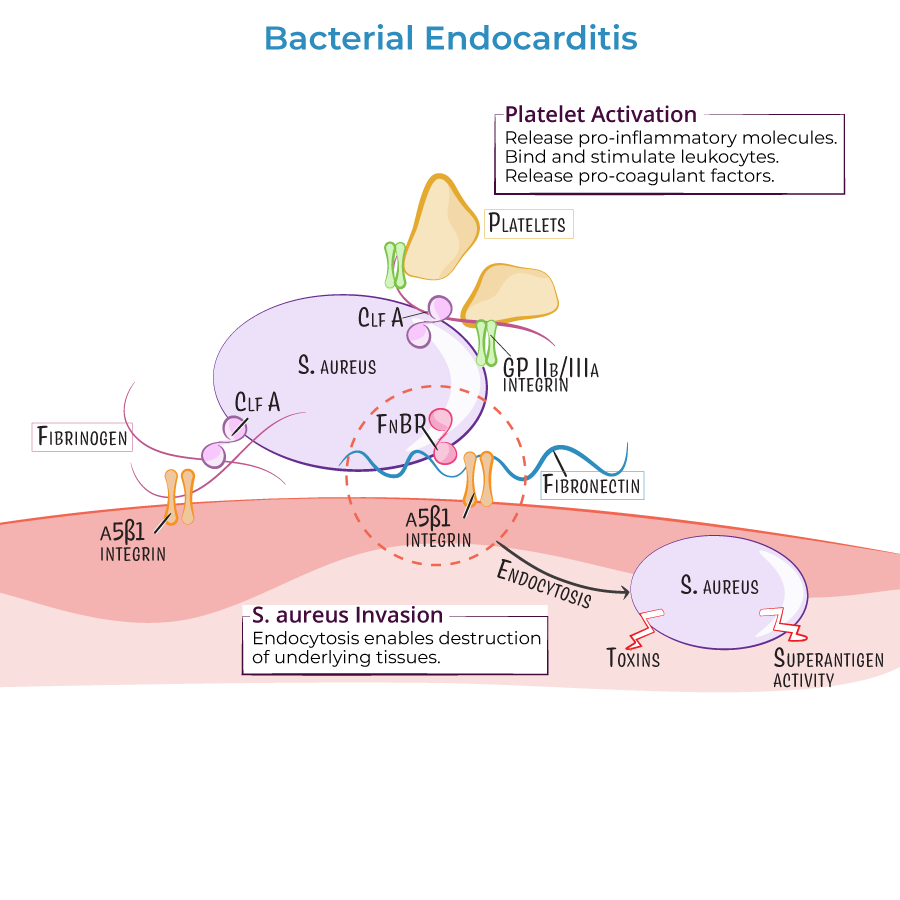
1. Fibronectin acts as a "bridge" between endothelial cells and bacteria.
2. Fibrinogen forms a bridge by adhering to S. aureus via Clumping factor A, and to endocardial cells via alpha-5 beta-1 integrin.
3. Platelets adhere to fibrinogen via integrin GPIIb/IIIa, forming connections that create a thrombus.
Treatment
1. Requires prolonged intravenous administration of antibiotics; S. aureus is resistant to penicillin.
2. Methicillin-resistant strains (MRSA) display changes in penicillin-binding proteins to increase tolerance.
3. For MRSA cases, vancomycin or daptomycin, sometimes in combination with other antibiotics, are administered intravenously.
- --
HIGH YIELD
Pathogenesis Details
1. Fibronectin and fibrinogen act as "connecting bridges" that adhere to host cells, platelets, and bacteria to form thrombotic vegetation.
2. Vegetations can break free and cause an embolism.
3. S. aureus produces a protective biofilm (slime layer) comprising polysaccharides and proteins that inhibit thrombus destruction.
4. S. aureus-fibronectin connection enables endocytosis into the endocardial cell.
5. Within host cells, S. aureus releases toxins and acts as a superantigen to provoke immune responses.
Clinical Manifestations
1. In the context of endocarditis, inflammation affects valves with vegetation blocking blood flow.
2. Endocarditis can affect the atrioventricular valve or walls of the heart (mural endocarditis).
3. If vegetation breaks free from the valve and travels in the bloodstream, it can become lodged in a vessel and cause embolism, even stroke.
Bacterial Strategies
1. S. aureus employs phenotypic switching to become small colony variants.
2. In this state, S. aureus "hides" from the host immune system and antibiotic treatments.
3. When conditions are favorable, bacteria can reemerge as an infective pathogen.
Thrombus Formation Mechanisms
1. Platelet activation induces release of pro-inflammatory molecules.
2. Activated platelets bind and stimulate leukocytes.
3. Pro-coagulation molecules are released, promoting thrombus formation and further immune system activation.
- --
Beyond the Tutorial
Additional Diagnostic Considerations
1. Duke criteria are used for diagnosis of infective endocarditis, including positive blood cultures and echocardiographic findings.
2. Transthoracic echocardiography (TTE) is the initial imaging study, but transesophageal echocardiography (TEE) has higher sensitivity.
3. Classic physical finding in endocarditis includes Janeway lesions (painless erythematous macules on palms/soles) and Osler nodes (painful raised lesions on fingers/toes).
Other Causative Organisms
1. Viridans group streptococci are common causes of subacute bacterial endocarditis.
2. Enterococci often cause endocarditis in elderly patients and those with GI/GU procedures.
3. HACEK group organisms (Haemophilus, Aggregatibacter, Cardiobacterium, Eikenella, Kingella) cause culture-negative endocarditis.
Complications and Management
1. Surgical intervention may be necessary for heart failure, uncontrolled infection, or prevention of embolic events.
2. Antibiotic prophylaxis is recommended for high-risk cardiac conditions undergoing dental procedures.
3. Long-term complications include congestive heart failure, valve dysfunction, and permanent neurological deficits from emboli.