
Start your One-Week Free Trial
Already subscribed? Log in »
Oral Absorption
Oral Absorption
- We'll define Fick's Law of Diffusion and then apply it to oral absorption in the gut.
We'll specifically address:
- The concentration gradient across the intestinal membrane between the intestinal lumen and plasma.
- The diffusion coefficient, which accounts for how easily a molecule is able to cross a membrane.
- The membrane thickness and area.
- We'll specifically focus on how the broad surface area of the intestine promotes absorption.
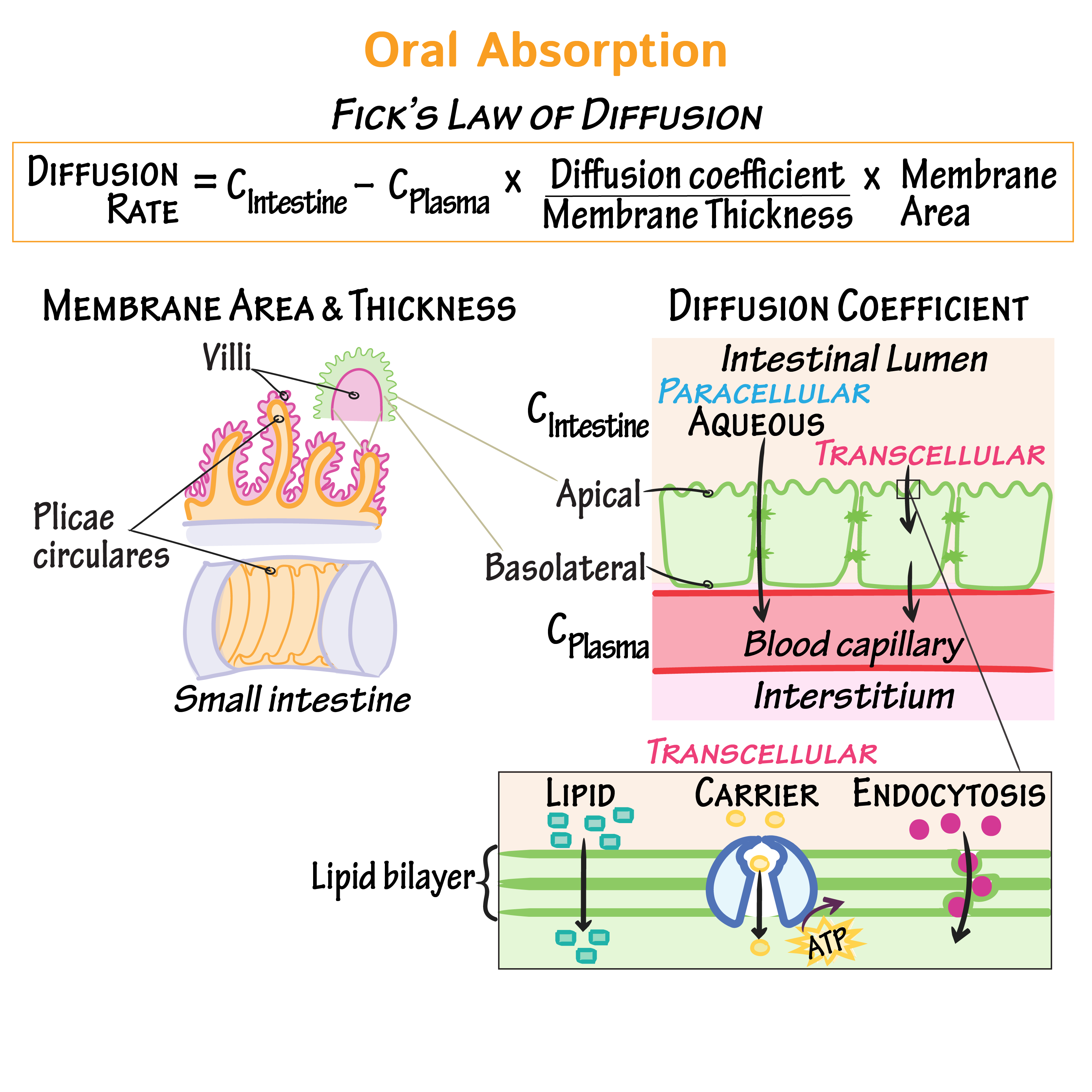
Fick's Law of Diffusion (as applied to the intestine)
Formula
- Diffusion Rate = Concentration (Intestine) – Concentration (Plasma) x (Diffusion Coefficient/Membrane Thickness) x Membrane Area
Membrane Area & Thickness
Overview
- We'll address intestinal anatomy and histology to better understand how the large surface area of the intestine impacts oral drug absorption: the uptake of materials from the intestinal lumen to the bloodstream and lymphatic vessels.
Physiology Review
- The small intestine, specifically the duodenum, is the major site of absorption.
- There are three folded mucosal structures that maximize surface area available for absorption: plicae circulares, villi, and microvilli (brush border).
- Thin membranes, such as the lungs, promote absorption; whereas thick membranes, eg the skin, form barriers (protection).
Intestinal Anatomy
- We show a longitudinal portion of the small intestine with a segment of its wall dissected away.
- The plicae ciculares form wavy folds on the inner walls of the tube: they form circular folds.
- We show several magnified plicae circulares, which provide a three-fold increase in surface area.
- The villi are finger-like projections that protrude from the plicae circulares, which provide a ten-fold increase in surface area. Arterioles, venules, and lymphatic vessels pass through the villi and uptake absorbed materials.
- We show one large villus and coat it with representative columnar epithelial cells, which have microvilli (aka brush border): hair-like projections that face the lumen of the small intestine. They provide a twenty-fold increase in surface area.
- All together, these folded layers produce a 600-fold increase in the surface area of the small intestine!
Diffusion Coefficient: Membrane Permeability
Permeability
- Lipid bilayers are semi-permeable (aka selectively permeable); they allow certain molecules and ions to pass through them.
Intestinal Epithelium
- Intestinal epithelial cells join with tight junctions.
- The apical surface interfaces the intestinal lumen and epithelium.
- The basolateral surface opposes the apical surface; it lines the inside of the villi: the interstitium.
- Drugs must cross both the apical and basolateral surfaces of the intestinal epithelium for absorption into circulation or the lymphatic system.
Concentration Gradient
- C(intestine) – C(plasma)
Diffusion Processes
Paracellular
- Aqueous diffusion
Transcellular
- Lipid diffusion
- Carrier-Transport
- Endocytosis
Key Molecular Factors that Determine the Diffusion Coefficient
The following factors impact the type of transport a molecule will utilize to cross a membrane (and thus its diffusion coefficient):
- Size (weight)
- Shape
- Charge
- Lipophilicity
Paracellular Diffusion
Aqueous Diffusion
- Via aqueous diffusion, small proteins pass through water-filled pores down a concentration gradient.
- This is a passive process governed by Fick's law.
Transcellular Diffusion
- Via transcellular diffusion, molecules pass through the apical membrane, epithelial cell, and basolateral membrane.
Lipid Diffusion
- Via lipid diffusion, proteins pass directly, passively, across the membrane from regions of higher concentration to lower concentration.
Carrier Diffusion
- The carrier transports the drug across the membrane.
- Some carriers involve energy requiring process.
- Others simply facilitate the passive diffuse of molecules across the membrane and are non-energy dependent.
- Carrier transport is generally used to bring across molecules that are too large or too lipophobic to passive traverse lipid membranes.
- Importantly, it is capacity limited, rather than limited by diffusion rate (ie, Fick's Law) like lipid diffusion.
Endocytosis
- Via endocytosis, there is an internalization of a molecule into a cell via infolding; this is an energy-dependent process.
- Exocytosis describes this process when it results in the molecule being released into the extracellular space.
- Pinocytosis describes endocytosis of small molecules. It helps to imagine this process as the membrane lapping-up ("drinking") tiny amounts of extracellular fluid and picking up small molecules in the process.
- Phagocytosis describes endocytosis of large molecules. It helps to imagine this process as the membrane swallowing or capturing ("eating") large protein chunks (eg, cellular debris). Phagocytosis is a key transport mechanism for large proteins and small proteins that bind with special proteins (B12 + Intrinsic Factor).
- Receptor-dependent (or clarthrin-dependent) endocytosis describes the employment of receptors to bind proteins for endocytosis. Clathrin is one of the best study coat-proteins, which are proteins coat the pits of plasma membrane and bind and sequester extracellular proteins.
Factors that Influence Pharmacokinetics
General Physiologic Considerations
- Kidney disease can produce reduced protein binding, which will decrease the affinity of the drug for the blood and increase the volume of distribution.
- Liver disease reduces drug metabolism and increases bioavailability.
- Congestive heart failure produces a low blood flow state, which reduces drug absorption.
Molecular Structure of Drugs
- Large, charged, molecules. (esp. those bound to plasma proteins) have an affinity for the intravascular space and thus have a low volume of distribution
- Small, hydrophilic molecules have an affinity for the extracellular fluid and thus have a medium volume of distribution.
- Small lipophilic molecules. (esp. those bound to tissue proteins) have affinity for tissues and have a high volume of distribution