
Start your One-Week Free Trial
Already subscribed? Log in »
Lithium
Indication
Bipolar disorder
- Lithium is primarily used in the treatment of bipolar disorder.
Mechanism of Action
Numerous Actions
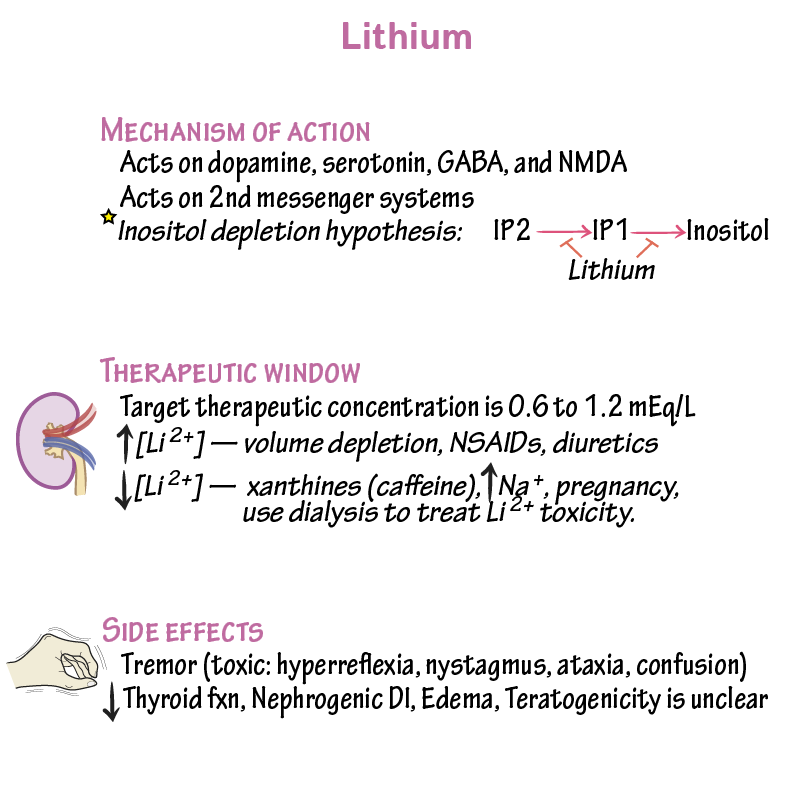
- Lithium acts at many neurophysiological levels, including on neurotransmitters such as dopamine, serotonin, GABA, and NMDA, and it acts on second messenger systems, such as adenylate cyclase and the phosphoinositide cycle.
Inositol depletion hypothesis
- We focus on this last mechanism, called the inositol depletion hypothesis, because it is putatively considered to be the most important.
- As part of this hypothesis, we highlight that lithium blocks the conversion of IP2 (inositol diphosphate) to IP1 (inositol monophosphate) and the conversion of IP1 to inositol, key steps in neuronal membrane inositol recycling. Specifically, it blocks inositol monophosphatase (IMPase) and inositol poliphosphatase (IPPase). This inhibition of inositol recycling results in a reduction of calcium release, diacylglycerol (DAG) activation, and protein kinase C activity.
Target Concentration (Narrow Window)
Target Concentration
- The target therapeutic concentration is 0.6 to 1.2 mEq/L, which is a narrow therapeutic window – it's easy for patients to become toxic or subtherapeutic.
Renally excreted
DECREASE Renal Clearance (leads to lithium toxicity)
- The following can DECREASE renal clearance and produce lithium toxicity: volume depletion, NSAIDs, and various diuretics: thiazides, angiotensin-converting enzyme inhibitors (ACEIs), and loop diuretics.
INCREASE Renal Clearance (leads to subtherapeutic lithium levels)
- On the other end of the spectrum, the following can INCREASE renal clearance and produce subtherapeutic levels: xanthines (caffeine and theophylline); increases in salt intake; pregnancy; dialysis – note that dialysis is used to treat lithium toxicity.
Side Effects
- Lithium is also known to impact additional systems that affect various physiologic processes including glucose metabolism; ADH secretion; thyroid hormones; and the hypothalamic-pituitary-adrenal axis, which leads us to some of the key side effects of lithium.
The following are important potential side effects:
- A coarse tremor is common even at therapeutic doses.
- Along these lines, at toxic doses, hyperreflexia, nystagmus, ataxia and confusion can occur.
- Decrease in thyroid function – there's the potential for goiter (thyroid enlargement) but rarely clinical hypothyroidism.
- Nephrogenic diabetes insipidus, manifesting with polydipsia and polyuria.
- Edema,
- Cardiac conduction defects – these are generally mild.
- Teratogenicity exists but the risk of congenital cardiac defects (Ebstein anomaly) is controversial.
- Other common symptoms include leukocytosis, acne, folliculitis.