
Start your One-Week Free Trial
Already subscribed? Log in »
Half-Life
Half-life
Overview
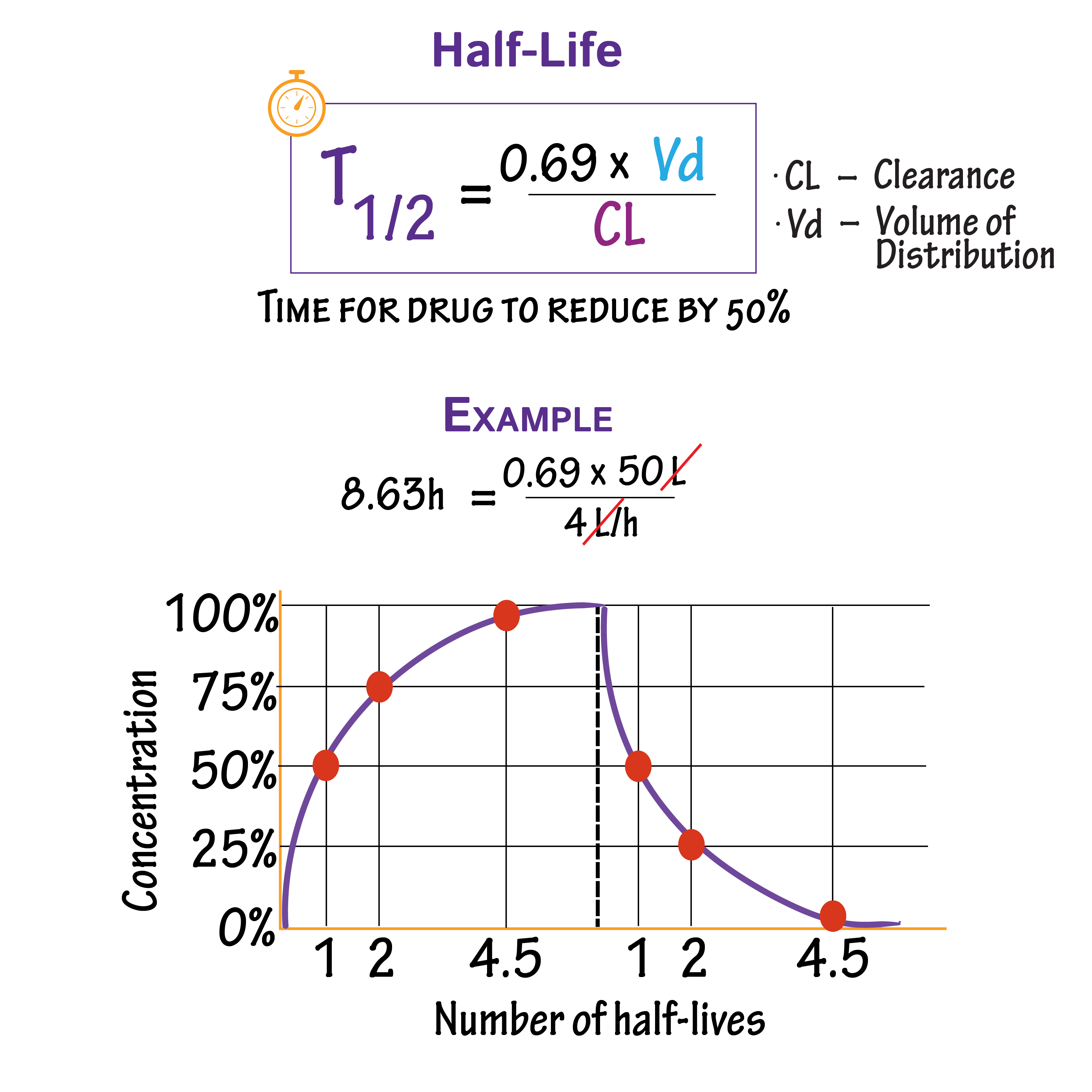
- Half-life is the time it takes for a drug to reduce in amount by 50%.
- The half-life allows us to predict the rate at which a drug will rise and fall in concentration, based on the volume of distribution and clearance.
Formula
- T(1/2) = (0.69 x Vd)/CL
- From this equation, we see that the key determinants of half-life are the Volume of Distribution and the Clearance, which we now can calculate, if we have the necessary values.
Example
Using the values we determined in this tutorial, let's calculate the half-life of our drug:
- (0.69 x 50 L)/4 (L/h)
- Cancel out the liter units
- Answer = 8.625h
Graphing Percentage of Maximum Concentration vs Number of Half-Lives
- Assume that we provide a steady intravenous infusion of medication. Indicate that:
- After 1 half-life, we are at 50% of steady state concentration
- After 2 half-lives, we are at 75% of steady state concentration
- After 4 – 5 half-lives, we are essentially at steady state concentration
- Next, assume that we stop the infusion. Demarcate this time point. Indicate that:
- After 1 half-life, 50% of the drug is gone.
- After 2 half-lives, 75% of the drug is gone.
- After 4 – 5 half-lives, the drug is mostly gone.
Steady State
- Steady state refers to the state of drug concentration in the body when the concentration of drug is no longer rising or falling. This occurs at 4-5 half lives because once that time is reached, every dose that goes IN will ultimately be gone in 4-5 half lives.
Dose Increase
- Increases in dose will increase the concentration at steady state but NOT the time it takes to reach steady state.
Time Interval Decrease
- Giving doses more frequently (reducing the time interval) will increase the overall drug concentration, as well, but not the time it takes to reach steady state.