
Start your One-Week Free Trial
Already subscribed? Log in »
Gastroenteritis
Gastroenteritis
SIGNS AND SYMPTOMS
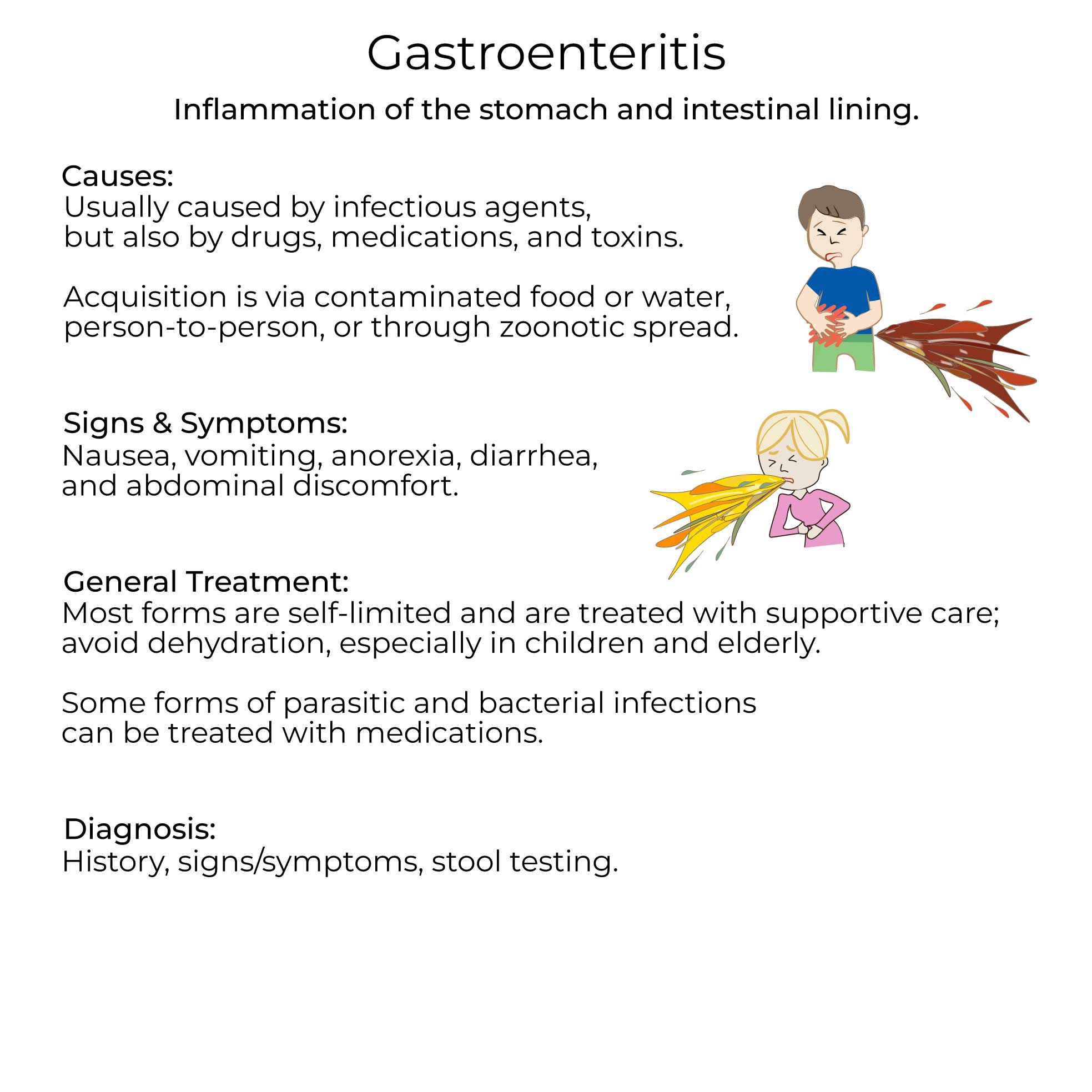
Nausea, vomiting, anorexia, diarrhea, and abdominal discomfort.
GENERAL TREATMENT
Most forms are self-limited and are treated with supportive care (be sure to avoid dehydration, especially in children and elderly).
Some forms of parasitic and bacterial infections can be treated with medications.
RISK FACTORS
Poor food/water hygiene
Recent antibiotic use
Immunocompromised state
Crowded settings (daycares, military barracks, nursing homes)
DIAGNOSIS
History, signs/symptoms, stool testing.
VIRAL GASTROENTERITIS
Acute onset with watery diarrhea, nausea, vomiting.
Self-limited, lasts up to 3 days.
Common pathogens:
Norovirus
Adenovirus
Astrovirus
Rotavirus, which is a common cause of gastroenteritis in children; it is highly contagious.
Learn more about viral gastroenteritis in this tutorial: Gastroenteritis & Hepatitis.
BACTERIAL GASTROENTERITIS
Acute onset with fever, bloody diarrhea, severe abdominal pain.
If contaminated food is the source, incubation period is up to 6 hours.
If bacterial infection is the source, incubation period is up to 3 days.
Self-limited, lasts up to 7 days. Antibiotics can treat diarrhea, but can cause complications (colitis).
Common pathogens:
E. coli
Salmonella
Shigella
Campylobacter
C. difficile
Lysteria.
Review these common pathogens in this full tutorial: E. coli, Salmonella, Shigella, Yersinia
PARASITIC GASTROENTERITIS
Onset within 7 days of exposure.
Usually characterized by watery diarrhea.
Self-limited, lasts 7 days or more.
Common pathogens:
Giardia
Entamoeba hystolytica
Cryptosporidium
Review these pathogens in these tutorials:
Giardiasis & Amebiasis
Cryptosporidium
Review Nematodes that cause intestinal infections: Nematodes