
PANCE - Valvular Disease
Start your One-Week Free Trial
Already subscribed? Log in »
Here are key facts for PANCE from the Valvular Disease tutorial, as well as points of interest at the end of this document that are not directly addressed in this tutorial but should help you prepare for the boards. See the tutorial notes for further details and relevant links.
1. Definitions:
Stenosis* = narrowed valve orifice impeding forward flow.
Regurgitation/Insufficiency* = valve fails to close → backward flow.
2. Most Common Valvular Disease:
 10. AV Valve Anatomy and Support:
 12. Myxomatous Valve Changes:
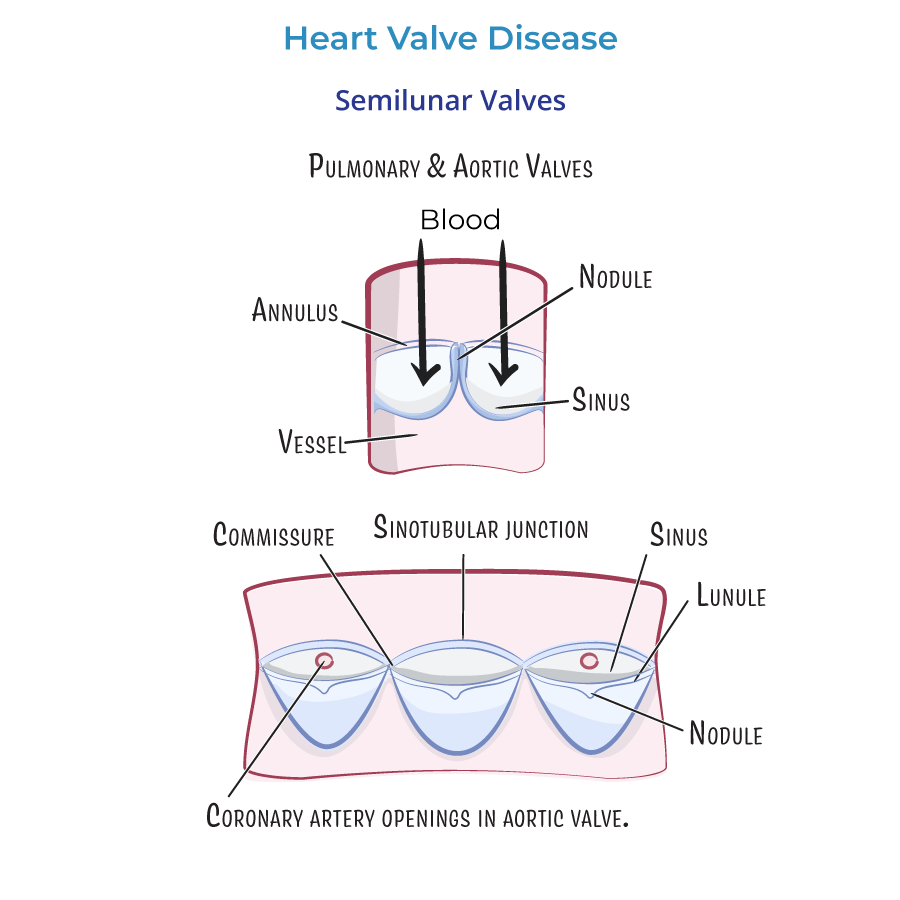
15. Nodule of Arantius:
23. Classic Murmur Findings:
Aortic stenosis*: systolic crescendo-decrescendo murmur, radiates to carotids.
Aortic regurgitation*: early diastolic decrescendo murmur, wide pulse pressure.
Mitral stenosis*: opening snap + diastolic rumble, best heard at apex in left lateral decubitus.
Mitral regurgitation*: holosystolic murmur, radiates to axilla.
24. PANCE Diagnostic Modalities:
12. Myxomatous Valve Changes:
15. Nodule of Arantius:
23. Classic Murmur Findings:
Aortic stenosis*: systolic crescendo-decrescendo murmur, radiates to carotids.
Aortic regurgitation*: early diastolic decrescendo murmur, wide pulse pressure.
Mitral stenosis*: opening snap + diastolic rumble, best heard at apex in left lateral decubitus.
Mitral regurgitation*: holosystolic murmur, radiates to axilla.
24. PANCE Diagnostic Modalities:
- --
VITAL FOR PANCE
- Aortic stenosis from degeneration and calcification with age; due to hydroxyapatite deposition.
- Present in \~1% of the population; accelerates calcification and stenosis.
- May be congenital or result from rheumatic heart disease.
- Connective tissue disorder associated with aortic root dilation, which can lead to aortic insufficiency.
- Post-rheumatic fever complication with characteristic “fish mouth”/buttonhole deformity.
- Fusion of leaflets and chordae tendineae.
- Leaflet ballooning during systole → regurgitation.
- Associated with myxomatous degeneration, calcification, and risk of stroke.
- Increased in patients with prosthetic valves or valvular calcification.
- Antibiotic prophylaxis recommended for dental procedures that breach the gingiva.
- Aortic valve: right, left, and posterior (non-coronary) cusps.
- Pulmonary valve: anterior, right, and left cusps.
- Prevent backflow into ventricles during diastole.
10. AV Valve Anatomy and Support:
- Mitral valve: anterior and posterior cusps, subdivided into A1–3 and P1–3.
- Chordae tendineae connect cusps to papillary muscles; disruption leads to functional regurgitation.
12. Myxomatous Valve Changes:
- Spongiosa layer deposits cause rubbery, thickened leaflets in prolapsed/calcified mitral valves.
- Seen in mitral valve calcification, raises stroke risk.
- Repetitive deformation (\~30 million contractions/year) causes structural damage and dysfunction.
- --
HIGH YIELD
- Central thickening on free edge of semilunar valve leaflet.
- The margin (free edge) of a semilunar leaflet.
- Arise from right and left aortic sinuses just above the aortic valve.
- Marks the transition between sinuses of Valsalva and the aorta/pulmonary trunk.
- Anchors AV valve leaflets; dysfunction leads to functional regurgitation (especially post-MI).
- Aortic cusps named for their proximity to coronary ostia (right coronary, left coronary).
- Caused by structural dysfunction (e.g., rupture of papillary muscle), not primary valve defect.
- A1–A3 and P1–P3 segments allow for precise surgical repair planning.
- --
Beyond the Tutorial
- First-line: transthoracic echocardiogram (TTE).
- TEE if poor windows or prosthetic valve/endocarditis suspected.
- CXR may show LA or LV enlargement.
- Symptomatic severe stenosis or regurgitation.
- Asymptomatic severe disease with LV dysfunction (EF <60%), LV dilation, or pulmonary hypertension.
- Needed in high-risk patients for dental, respiratory, or infected tissue procedures.
- Mitral stenosis worsens in pregnancy due to increased preload.
- Prefer bioprosthetic valves in women of childbearing age to avoid warfarin.
- Lifelong anticoagulation for mechanical valves (goal INR 2.5–3.5).
- Routine surveillance echocardiograms to monitor prosthetic function.
- Heart failure, atrial fibrillation, stroke, thromboembolism, infective endocarditis.
- Treatment for mitral stenosis in select non-calcified cases (especially in young patients).