
PANCE - Hyperlipidemia Pathophysiology
Start your One-Week Free Trial
Already subscribed? Log in »
Here are key facts for PANCE from the Hyperlipidemia Pathophysiology tutorial, as well as points of interest at the end that are not directly addressed in this tutorial but should help you prepare for the boards.
- --
VITAL FOR PANCE
Overview and Classification
1. Definition and impact: Hyperlipidemia is often asymptomatic, but it significantly increases one's risk for cardiovascular diseases, especially atherosclerosis
2. Classification systems: The older scheme, which focuses on inherited lipidemias, is called the Fredrickson Classification system. The newer system divides lipidemias according to primary (aka, genetic) or secondary (aka, acquired) causes
3. Primary vs. Secondary: Primary lipidemias can be exacerbated by secondary causes
Lipoprotein Metabolism
1. Lipoprotein function: Comprise proteins and phospholipids that transport cholesterol and triglycerides in the body
2. LDL ("bad" cholesterol): LDL is sometimes referred to as "bad" cholesterol, because it distributes cholesterol throughout the body and vessels. In the vessels, the deposited cholesterol contributes to obstructive plaque formation and atherosclerosis
3. HDL ("good" cholesterol): High Density Lipoproteins, which are part of the reverse cholesterol transport pathway, carry cholesterol from the peripheral tissues to the liver. In addition to removing excess cholesterol, High Density Lipoproteins have various other anti-atherogenic properties, so it they are often referred to as "Good" cholesterol
Diagnostic Criteria
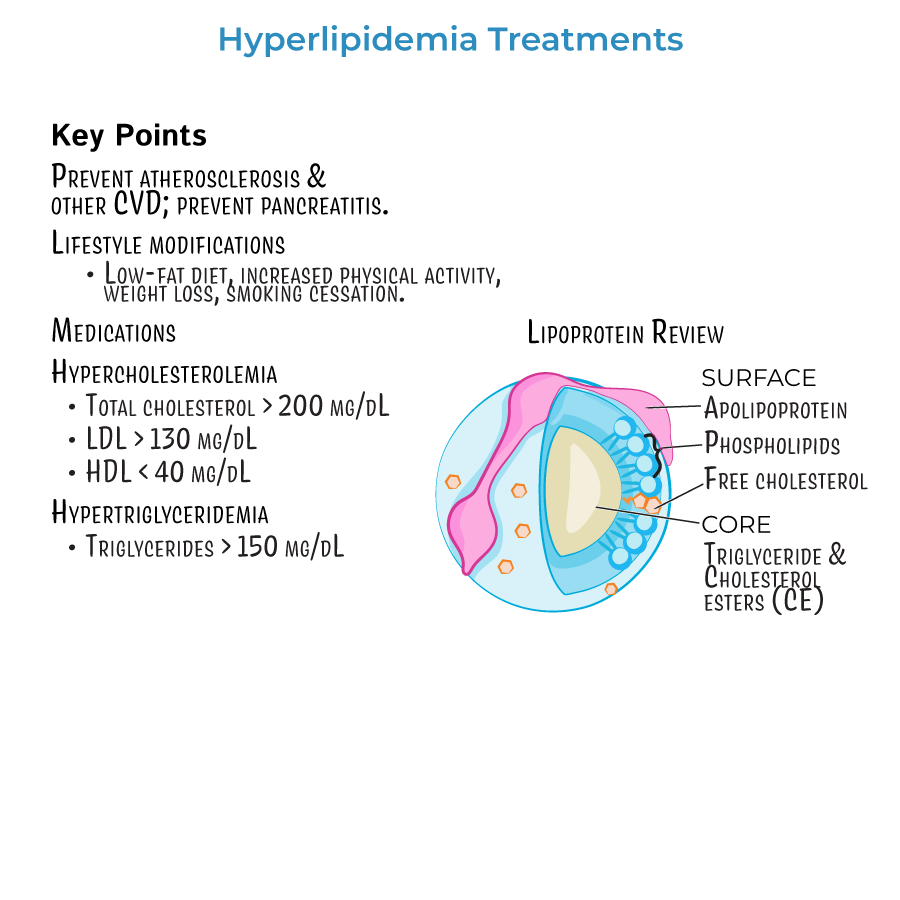
1. Hypercholesterolemia: Hypercholesterolemia is often defined as: Total cholesterol > 200 mg/dL, Low-Density Lipoproteins > 130 mg/dL, High-Density Lipoproteins < 40 mg/dL
2. Hypertriglyceridemia: Hypertriglyceridemia = levels above 150 mg/dL
Clinical Manifestations
1. Xanthomas definition: These are created by lipid deposits in the skin associated with foam cells (macrophages that have ingested lipids)
2. Types of xanthomas: Tuberous xanthomas form small to large bulges in the skin over the joints, particularly the elbows and knees. Eruptive xanthomas are erythematous bumps that tend to appear on the buttocks, shoulders, and extensor surfaces. Plane xanthomas are thin yellow plaques. Xanthelasma is characterized by plaques around the eyelids. Palmar xanthomas are characterized by yellow plaques that form along the creases of the palm of the hands. Tendinous xanthomas are bumps that form over the tendons or ligaments
- --
HIGH YIELD
Primary Hyperlipidemias and Clinical Correlations
1. Type I (Hyperchylomicronemia): Occurs when there is a deficiency in lipoprotein lipase or an alteration in apolipoprotein C-II, which activates lipoprotein lipase. These deficiencies cause elevated chylomicrons and triglyceride levels exceeding 500 mg/dL. This disorder is associated with acute pancreatitis, eruptive xanthomas, and, when triglyceride levels are exceedingly high, lipemia retinalis
2. Type IIa (Hypercholesterinemia): Occurs when LDL receptors are deficient. Results in elevated Low-Density Lipoproteins and cholesterol. There are heterozygous and homozygous forms. Patients are at increased risk of premature Atherosclerotic Cardiovascular Disease (ASCVD), tendinous xanthomas, and, corneal arcus, which is a whitish ring around the iris
3. Type IIb (Hyperlipidemia): Occurs when there is a reduction in LDL receptors or increased apolipoprotein B. Characterized by elevated Low Density Lipoproteins and Very Low Density Lipoproteins. Both triglycerides and cholesterol are also elevated. Patients are at increased risk of premature ASCVD and may have tendinous xanthomas. This is the most common inherited dyslipidemia
4. Type III (Dysbetalipoproteinemia): Occurs when apolipoprotein E-2 is defective. The disorder is characterized by elevated chylomicron remnants and Intermediate Density Lipoproteins (hence, this disorder is sometimes called Remnant Removal Disease). Both triglyceride and cholesterol levels are elevated. Patients are at increased risk of ASCVD, and may have palmar xanthoma and/or tuberoeruptive xanthomas of the elbows and knees
5. Type IV (Hypertriglyceridemia): Characterized by increased production and decreased secretion of Very Low Density Lipoproteins. Elevated levels of triglycerides. Patients are at increased risk for acute pancreatitis and ASCVD. Type IV is another relatively common inherited hyperlipidemia
6. Type V (Mixed hypertriglyceridemia): Associated with increased Very Low Density Lipoprotein production and decreased Low Density Lipoprotein production. Characterized by elevations in chylomicron remnants and VLDL. Increased triglyceride and cholesterol levels. Patients are at risk for acute pancreatitis, eruptive xanthomas, and ASCVD
Secondary Causes of Hyperlipidemia
1. Lifestyle factors: The most significant contributors in the United States are diets high in saturated fats, cholesterol, and trans fats, coupled with sedentary lifestyles
2. Alcohol consumption: High levels of alcohol consumption also elevate lipid levels
3. Medical conditions: Several other disorders may contribute to hyperlipidemia, including: diabetes mellitus, chronic kidney disease, nephrotic syndrome, hypothyroidism, cholestatic liver diseases, and Cushing syndrome
4. Medication-induced: Several drugs can cause hyperlipidemia, including oral contraceptives, diuretics, beta-blockers, and antiretroviral agents
- --
Beyond the Tutorial
Below is additional information important for the PANCE exam:
Clinical Assessment
1. Comprehensive history: Family history of premature CAD, personal cardiovascular risk factors
2. Physical examination: Focus on xanthomas, corneal arcus, and cardiovascular system
3. Laboratory evaluation: Fasting lipid panel, liver function tests, thyroid function tests
Management Approaches
1. Lifestyle modifications: Dietary counseling, exercise prescription, weight management
2. Pharmacologic therapy: Statins, fibrates, bile acid sequestrants, ezetimibe, PCSK9 inhibitors
3. Special considerations: Diabetes, metabolic syndrome, chronic kidney disease
Patient Education and Monitoring
1. Risk factor modification: Smoking cessation, blood pressure control, diabetes management
2. Medication adherence strategies: Understanding side effects, monitoring protocols
3. Follow-up assessment: Lipid panels, liver function tests, symptom evaluation