
ABIM - Small Vessel Vasculitis
Start your One-Week Free Trial
Already subscribed? Log in »
Here are key facts for ABIM from the Small Vessel Vasculitis tutorial, as well as points of interest at the end of this document that are not directly addressed in this tutorial but should help you prepare for the boards. See the tutorial notes for further details and relevant links.
 5. Eosinophilic Granulomatosis with Polyangiitis (EGPA):
 6. Microscopic Polyangiitis (MPA):
- --
VITAL FOR ABIM
General Principles of Vasculitis
1. Small vessel vasculitides cause inflammation and necrosis of capillaries, venules, and arterioles, leading to multi-organ ischemia.
2. Systemic signs: fever, weight loss, fatigue, arthralgias, myalgias, and cutaneous palpable purpura.
3. Initial therapy: high-dose corticosteroids, escalating to immunosuppressants (e.g., rituximab, cyclophosphamide) for major organ involvement.
ANCA-Associated Small Vessel Vasculitides
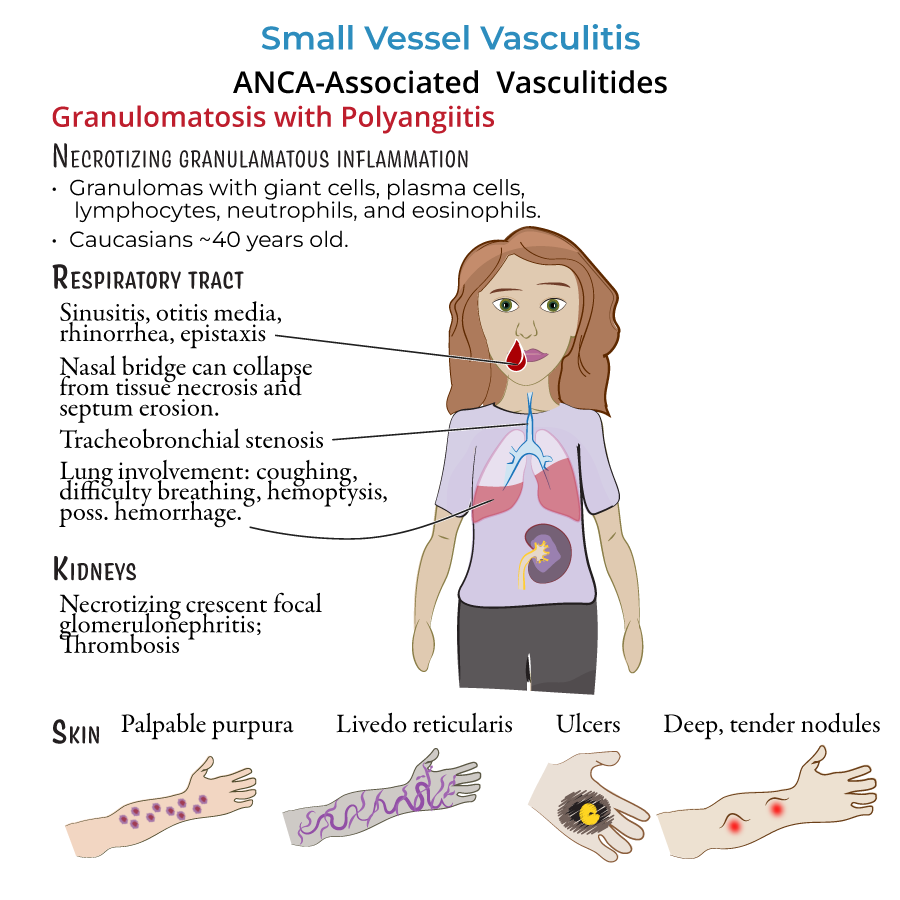
4. Granulomatosis with Polyangiitis (GPA):
- Upper airway: chronic sinusitis, nasal crusting, epistaxis, saddle-nose deformity.
- Lungs: cough, hemoptysis, cavitary nodules on imaging.
- Kidneys: rapidly progressive glomerulonephritis (RPGN).
- Skin: palpable purpura, ulcers.
- Labs: positive c-ANCA (anti-proteinase 3).
- Biopsy: necrotizing granulomatous inflammation.
- Treatment: corticosteroids + rituximab or cyclophosphamide.
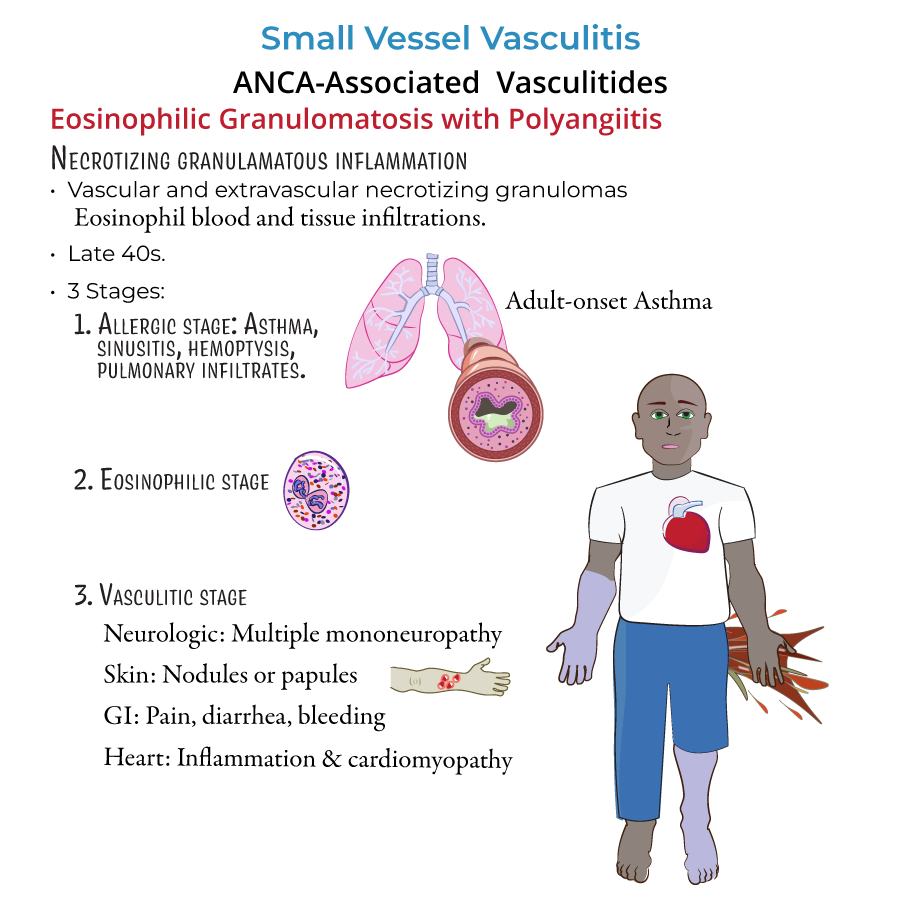
5. Eosinophilic Granulomatosis with Polyangiitis (EGPA):
- Features: adult-onset asthma, eosinophilia, systemic vasculitis.
- Cardiac involvement is the major cause of mortality (myocarditis, heart failure).
- Mononeuritis multiplex (neuropathy).
- Labs: positive p-ANCA (anti-myeloperoxidase).
- Biopsy: eosinophilic infiltration with granulomas.
- Treatment: corticosteroids alone for mild disease; corticosteroids + cyclophosphamide/mepolizumab for severe cases.
6. Microscopic Polyangiitis (MPA):
- Presents with RPGN and pulmonary capillaritis (alveolar hemorrhage).
- No granulomas on biopsy (distinguishing from GPA).
- Labs: positive p-ANCA.
- Treatment: corticosteroids + rituximab or cyclophosphamide.
- --
HIGH YIELD
Non-ANCA Small Vessel Vasculitides
1. IgA Vasculitis (Henoch-Schönlein Purpura):
- Most common vasculitis in children but can occur in adults.
- Classic tetrad:
- Palpable purpura (legs, buttocks).
- Arthralgia/arthritis.
- Abdominal pain (GI bleeding possible).
- Renal involvement (hematuria, mild proteinuria).
- Biopsy: IgA deposition in mesangium.
- Management: supportive for mild cases; corticosteroids for severe renal or GI involvement.
- Caused by cryoglobulin precipitation at low temperatures.
- Associated with Hepatitis C virus (HCV).
- Clinical triad:
- Palpable purpura.
- Arthralgia.
- Glomerulonephritis.
- Labs:
- Positive cryoglobulins.
- Low complement levels (especially C4).
- Management:
- Antiviral therapy for underlying HCV.
- Immunosuppressive therapy if severe (rituximab + corticosteroids).
- May develop secondary small vessel vasculitis later in disease course.
- Important to monitor for systemic vasculitis flares.
- --
Beyond the Tutorial
Diagnostic Approach
1. ANCA testing:
- c-ANCA (PR3) → GPA.
- p-ANCA (MPO) → MPA, EGPA.
Imaging
3. Chest CT:
- GPA: cavitary nodular lesions.
- MPA: diffuse alveolar infiltrates if hemorrhage.
- Crescentic glomerulonephritis in GPA and MPA.
Treatment Nuances
5. GPA, MPA severe disease:
- Induction: corticosteroids + rituximab or cyclophosphamide.
- Maintenance: azathioprine, methotrexate, or rituximab.
- Mild (asthma only): corticosteroids alone.
- Severe (cardiac, neurologic): corticosteroids + cyclophosphamide or mepolizumab.
- Priority is treating Hepatitis C with antivirals.
- Immunosuppress if life-threatening disease.
Complications to Watch For
8. GPA:
- Pulmonary hemorrhage.
- Renal failure.
- Nasal septal perforation.
- Eosinophilic myocarditis leading to heart failure.
- Pulmonary-renal syndrome.
- Chronic kidney disease, peripheral neuropathy.