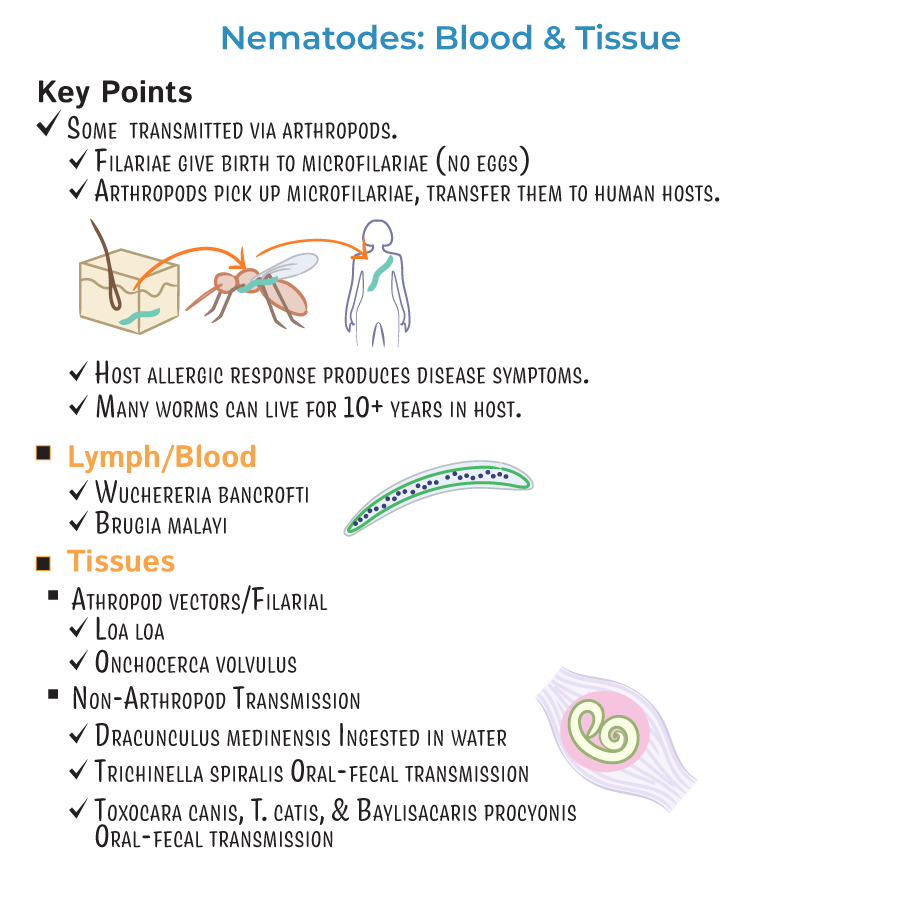
Nematodes - Blood and Tissue Infections
Filariae
Some of the parasites we'll learn in this tutorial are transmitted by arthropods, specifically, mosquitoes and flies.
These parasites are often referred to as
filariae, and they give birth to
microfilariae, which transition to larval stages. They do not lay eggs, as many other nematodes do.
Arthropods ingest the microfilariae during a blood meal, then transfer them to a new host.
In many cases, the host's immune response produces the disease symptoms, and eosinophilia is common.
Many worms can survive in their human hosts for a decade or longer.
Filariae that infect the blood and lymph: Wuchereria bancrofti and Brugia malayi
Filariae that infect the tissues: Loa loa, Onchocerca volvulus
Non-filarial nematodes that infect the tissues but are not transmitted by arthropods: Dracunculus medinensis, which is ingested in water; Trichinella spiralis, which is ingested in meat; Toxacara canis, Toxacara catis, and Baylisacaris procyonis; these species are transmitted via the fecal-oral route.
Wuchereria bancrofti and Brugia malayi
Wuchereria bancrofti and Brugia malayi cause lymphatic filariasis.
Microfilariae are transmitted by mosquitoes.
Microfilariae have tapered tails, and characteristic sheaths (Onchocerca volvulus has a similar appearance).
Larvae grow to adults and reproduce in the host lymphatic system.
Infection can lead to swelling, most commonly in the lower extremities; upon repeated exposure or in more serious infections, fibrous tissue can form around the parasites.
When this blocks the lymphatic flow, massive swellings in the groin and legs occur; this is called elephantiasis.
Adult nematodes rely on a bacterial endosymbiont,
Wolbachia, for their metabolic and reproductive functions.
– Thus, alternative treatments for lymphatic filariasis target these bacteria.
Onchocerca volvulus
Microfilariae are transmitted by black flies.
In the host, adults become encapsulated in deep subcutaneous nodules.
Larval offspring escape the nodules and migrate to other body tissues; itching is common.
Lymphatic flow can be obstructed by the worms. As a result of lymphatic obstruction, swellings often develop in the inguinal and femoral regions; due to their location, the swellings produce a condition known as
"hanging groin."
Occupied by Wolbachia bacteria; when the worms die, the bacteria are released in the human host.
Microfilariae and Wolbachia bacteria can cause various ocular infections and lead to blindness; this is often called "River blindness" because the parasites and vector are associated with rivers and streams.
Onchocerca is a
significant cause of blindness worldwide, and is most common in areas of Africa.
Loa loa
Microfilariae are transmitted by biting flies.
Adults move through the subcutaneous tissues, in the muscles, and under the conjunctiva of the eye. Worm movement and angioedema produce subcutaneous swellings that may be itchy.
Swellings are referred to as
Calabar or
fugitive swellings.
The ability of the worm to travel under the eye conjunctiva helps us remember its nickname:
African eye worm. –– Can cause eye congestion and sensitivity, though permanent damage is not common.
Dracunculus medinensis (also called "Guinea worm")
Larvae infect microcrustaceans, called copepods, of the Cyclops genus; humans then ingest the microcrustaceans in drinking water.
The larvae are released into the human gastrointestinal tract, and adult females move to the subcutaneous tissues to give birth. In the tissues, the females become enclosed in a vesicle that eventually produces an ulcer in the host's skin. The female protrudes part of her uterus through this opening, and, upon contact with water, releases her larvae to the external environment.
Trichinella spiralis
Primary cause of trichinellosis, also called trichinosis. Be aware that other species of Trichinella can also cause trichinellosis.
Humans and other meat-eating animals are exposed to Trichinella when they eat the undercooked flesh of infected animals. Because pigs are omnivores, pork products are a significant source of trichinellosis in humans.
In the human gastrointestinal tract, adult worms reproduce. The larvae exit the GI tract and migrate to striated muscles, including cardiac and skeletal muscle tissue.
In the skeletal muscles, the larvae encyst and can calcify; some species of Trichinella do not encyst, but can nevertheless remain viable for several years.
Symptoms of trichinellosis vary, and depend on worm load and location:
Early infection, if symptomatic, is characterized by abdominal pain and gastrointestinal symptoms.
The muscle stage develops approximately a week later, and is characterized by muscle pain and swelling caused by worm migration in the tissues and the inflammatory response.
Skeletal muscle throughout the body can be infected, including the tongue and diaphragm. Pain, swelling, and weakness can be severe enough to limit movement and breathing.
Other indicators of trichinellosis include periorbital and facial swellings, retinal and conjunctival hemorrhaging, and subungual splinter hemorrhages (during the diagnostic stage, look for small dark red vertical lines under the nails).
More serious infections can involve the heart, lungs, and brain.
Toxocara canis, Toxocara catis, and Baylisacaris
Toxocara canis, Toxocara catis, and Baylisacaris
Associated with dogs, cats, and raccoons, respectively.
Unlike the others we've learned in this tutorial, these parasites are ingested as eggs. In the human host, the larvae hatch and migrate to various tissues.
Toxocara species typically migrate to the viscera and eye; infections may be asymptomatic, but serious organ damage with granuloma formation can also occur, especially in the liver or lungs.
Baylisacaris procyonis, also known as "raccoon roundworm," causes fulminant eosinophilic meningoencephalitis.