

Start your One-Week Free Trial
Already subscribed? Log in »


Cestodes: Overview
Cestodes: Flatworms
Anatomy:
No digestive systems; they absorb nutrients through their body walls.
They are hermaphroditic, with both male and female reproductive organs.
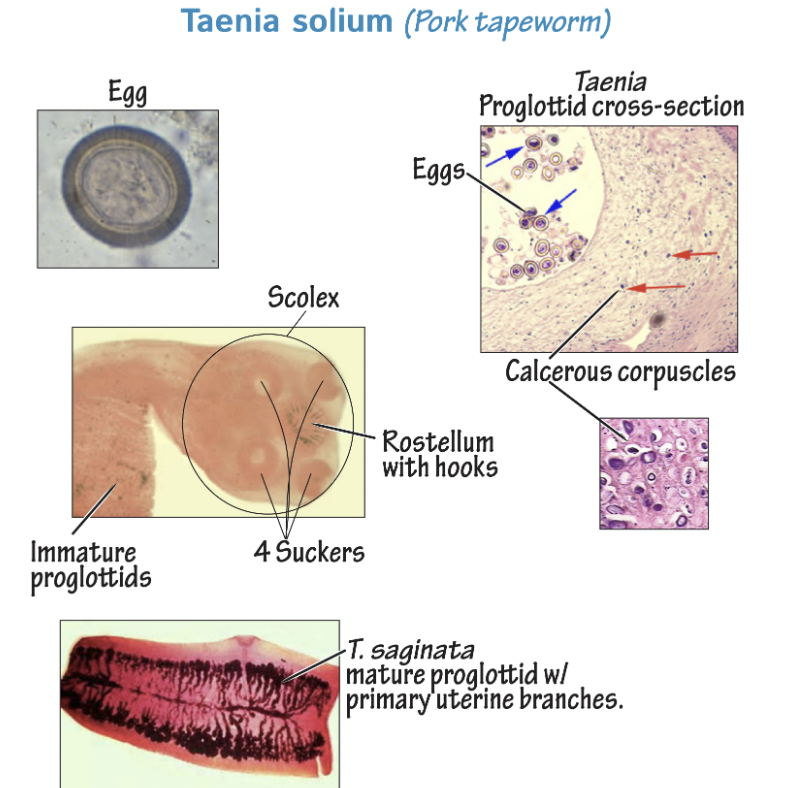
Anterior ends comprise the scolex, with suckers and a rostellum with hooklets that are used for attaching to the host.
The body is called the *strobila and comprises multiple segments called proglottids. The distal, more mature proglottids house uteruses with eggs; these are called gravid proglottids. The outer covering is tegument.
Cestodes develop from proximal to distal: as the immature proglottids develop at the anterior end, the mature proglottids move distally. The most distal segments comprise proglottids with uteruses full of eggs; thus, they are the gravid proglottids.
The gravid proglottids break free, and release their eggs.
Life Cycles:
Many cestodes have complex life cycles with one or more intermediate hosts.
When humans host the adult forms, cestode infections are often asymptomatic, although some people experience abdominal pain, diarrhea, and other gastrointestinal problems.
Larvae exit the eggs and are ingested by intermediate hosts. In these hosts, which range from insects to fish, the larvae undergo transformations that produce infective forms.
Humans ingest the infective larvae; this usually occurs when humans eat the intermediate host. In the small intestine, the parasites mature to the adult form and produce gravid proglottids.
The proglottids release eggs, which are then passed to the environment in the feces.
Diagnosis & Treatment:
Diagnosis is confirmed by the finding of eggs or proglottids in the stool.
Praziquantel can be administered as treatment.
Infections are more serious when humans host the larval stages of some cestodes, which form damaging cysts.
Diphyllobothrium latum

Hymenolepis nana
Taenia solium & Taenia saginata
Echinococcus granulosus
