
Start your One-Week Free Trial
Already subscribed? Log in »

Intramembranous Ossification
Introduction
Summary
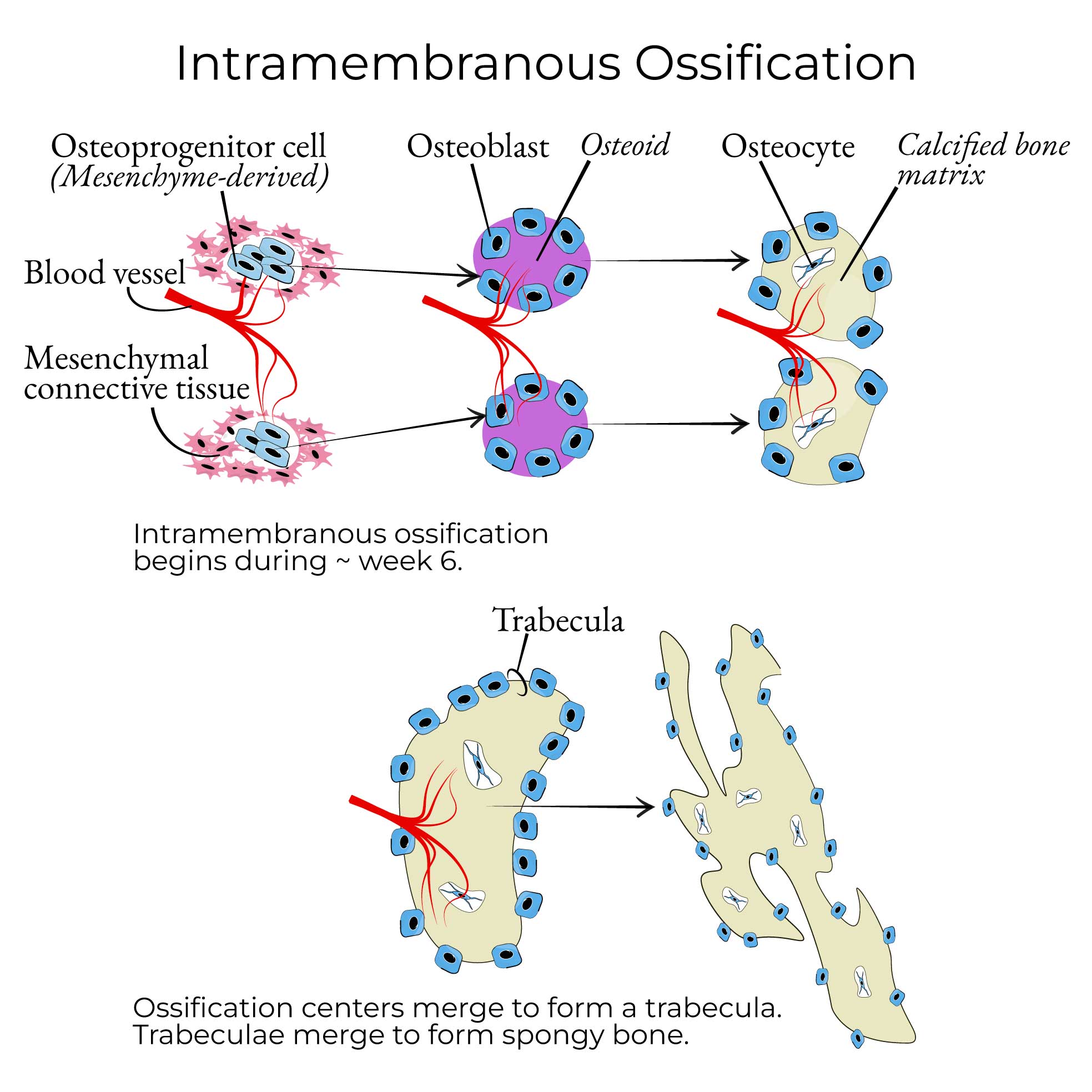
Intramembranous ossification is a DIRECT form of ossification, which originates with mesenchymal tissue that directly differentiates bone. In intramembranous ossification no cartilaginous model is formed.
Intramembranous Bones
The following bones undergo intramembranous ossification
- Flat bones of the skull (the cranial vault).
- Facial bones of the skull (including the maxilla and the mandible).
- Clavicle (the majority of it).
Intramembranous Ossification
Mesenchyme
Mesenchymal cells condense within their fibrous connective tissue membranes.
Osteoprogenitor Cells
Mesenchymal cells differentiate into osteoprogenitor cells: bone-forming cells.
Osteoblasts
Osteoprogenitor cells differentiate into osteoblasts that further organize themselves in the ossification centers.
Osteoid
Osteoblasts secrete osteoid, which is a collagenous precursor to mineralized bone. It lacks the calcium and phosphate required for mineralization (calcification, hardening).
- Consider that in osteomalacia, “soft bone disease”, the bones lack the necessary vitamin D, calcium, or phosphate to appropriately mineralize, so the bones are too soft.
Trabecula Formation
The ossification centers develop into ossified trabeculae.
Bone Matrix
The osteoid hardens to form bone matrix.
Osteocytes
Osteoblasts that are trapped in the bone matrix become osteocytes. They reside in lacunae (cavitations) and possess cytoplasmic processes within canaliculi that help them communicate with the rest of the bone.
- This can help us remember that although it is a hard substance, bone is an active body tissue.
Trabecula
The ossification centers merge into a single structure, which we call a trabecula (plural, trabeculae).
Intramembranous Bone Layers
Periosteum (Outer Layer): Collagen Fiber
Periosteum possess an outer layer of collagen fiber tissue.
Periosteum (Inner Layer): Row of Osteoblasts
Periosteum also possess an inner layer of osteoblasts (the cambium layer).
- These osteoblasts that are requisite for appositional growth – bone widening/thickening, which continues throughout life.
Compact bone
Compact bone underlies periosteum on each side. It provides a more rigid, protective structure.
Spongy bone
In the center is spongy bone, which constitutes trabeculae populated with osteocytes, and is covered in endosteum that possess osteoprogenitor cells that can differentiate into osteoblasts for bone formation.
Red Marrow and Vascularization.
Red marrow (hematopoietic stem cells and various other hematopoietic cell types) and blood vessels lie within the spongy bone.