

Start your One-Week Free Trial
Already subscribed? Log in »
Capillary
Three types of capillaries, which are categorized by how permeable they are: continuous, fenestrated, and sinusoidal, aka, discontinuous.
In a sample viewed through an electron microscope, we can see the red blood cell in the lumen of the capillary; notice it takes up a lot of the area of the lumen.
We label the indicate the endothelial cell and basement membrane.
Continuous capillaries
Continuous capillaries are lined by a continuous layer of simple squamous endothelium surrounded by a basement membrane; diffusion of small molecules occurs through tight junctions between the endothelial cells. These capillaries are found throughout the body, including the brain, Brain, muscle, skin, and lungs.
Fenestrated capillaries
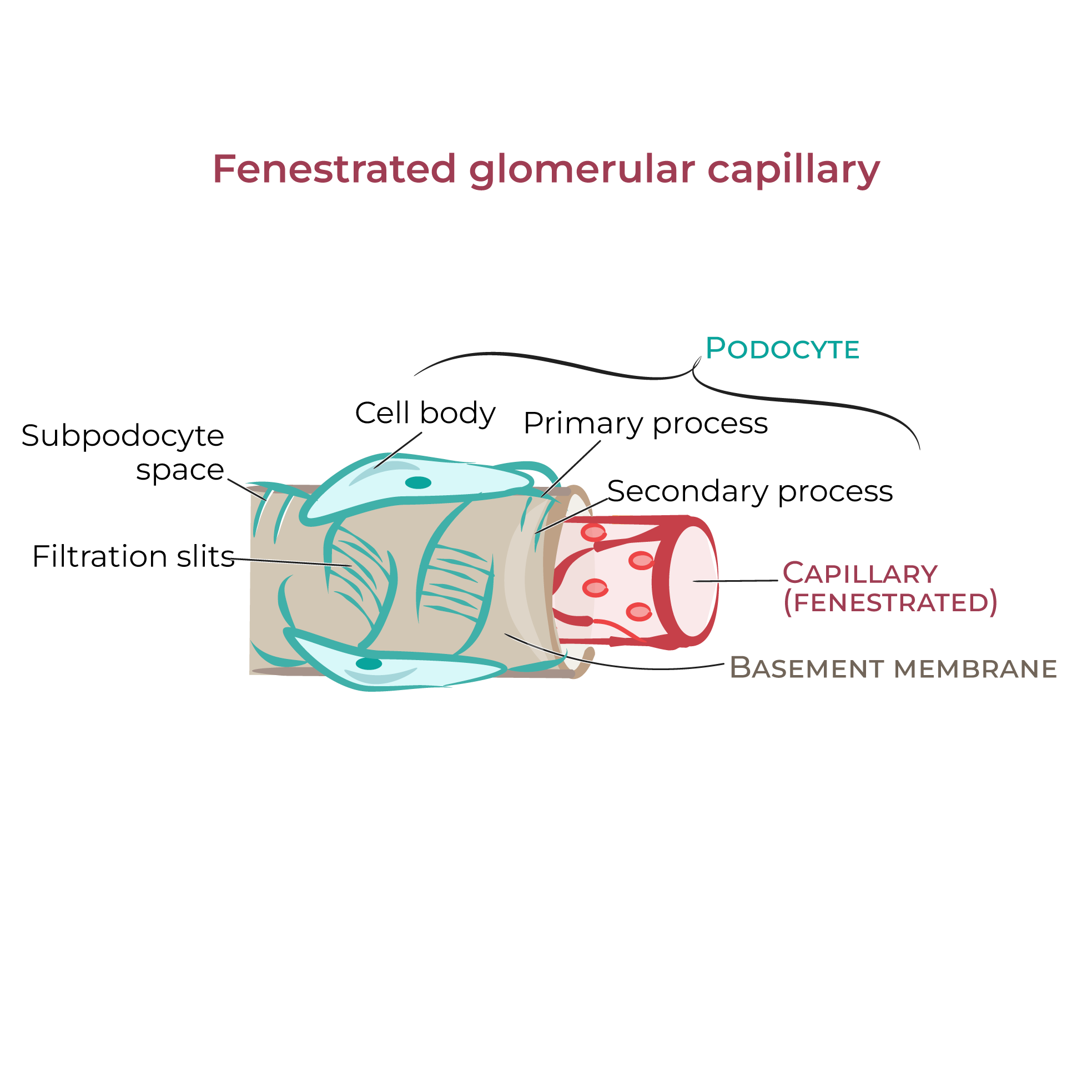
Fenestrated capillaries have pores, aka, fenestrae (fenestrae is Latin for “windows”), through which mid-sized molecules, such as water and glucose, can pass. Thus, fenestrated capillaries are located in the kidneys and intestines.
Discontinuous capillaries
Discontinuous/sinusoidal capillaries have has gaps in their endothelia and basement membranes. These capillaries are found in the liver and spleen, where larger molecules, such as white blood cells, are filtered from the blood.