

Start your One-Week Free Trial
Already subscribed? Log in »

Posterior Abdominal Wall Nerves: Lumbar Plexus
Lumbar Plexus in Isolation
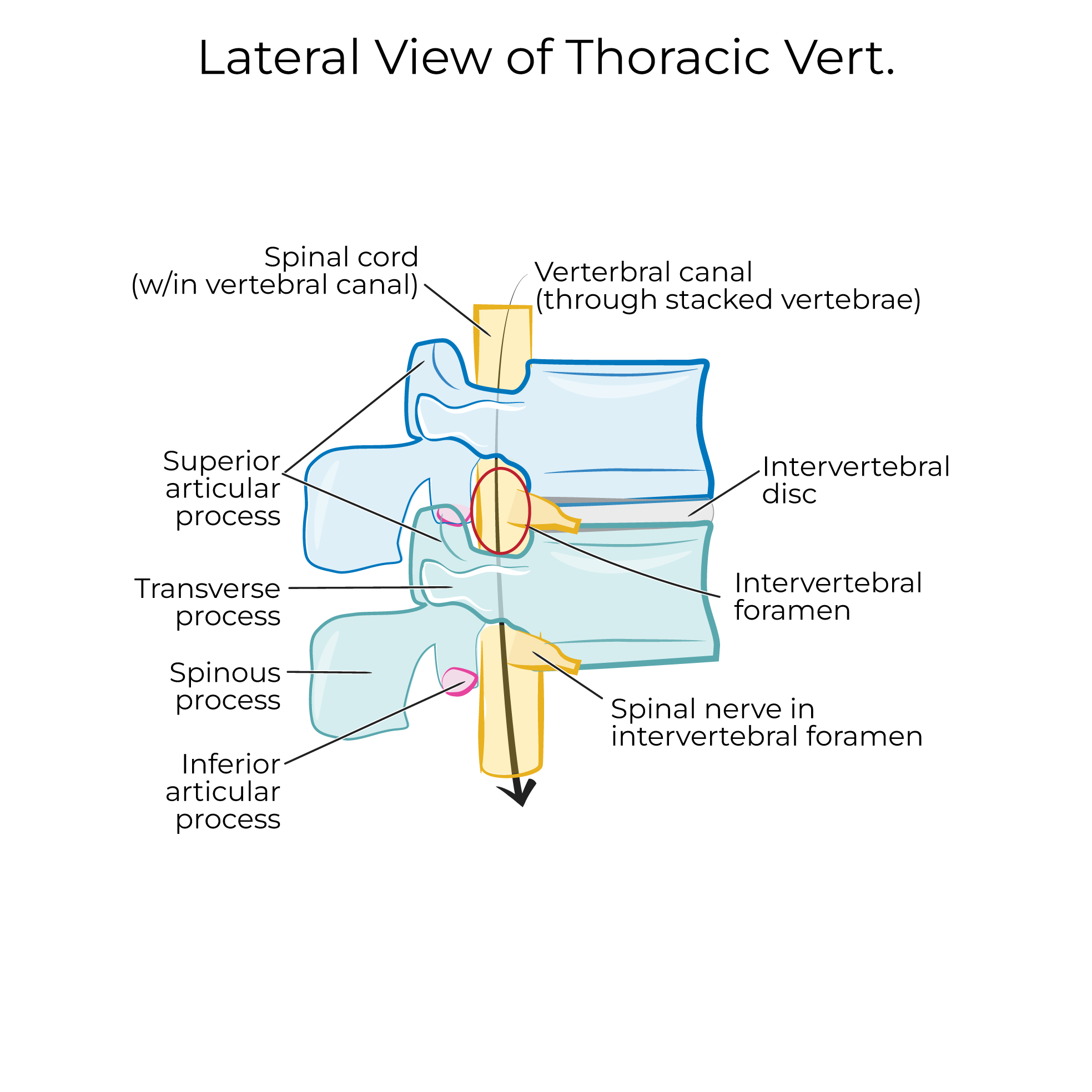 The spinal nerves then divide into anterior and posterior rami, which comprise sensory and motor fibers.
Posterior rami pass posteriorly to supply back muscles and skin; since we're focusing on the lumbar plexus, we'll omit the posterior rami.
The anterior rami, which are the focus of this tutorial, divide into anterior and posterior divisions, and, as the lumbar plexus, pass laterally and inferiorly to supply the skin and muscles of the lower trunk and lower extremity. The lumbar plexus forms anterior to the transverse processes of the lumbar vertebrae and within the proximal attachment of psoas major.
The spinal nerves then divide into anterior and posterior rami, which comprise sensory and motor fibers.
Posterior rami pass posteriorly to supply back muscles and skin; since we're focusing on the lumbar plexus, we'll omit the posterior rami.
The anterior rami, which are the focus of this tutorial, divide into anterior and posterior divisions, and, as the lumbar plexus, pass laterally and inferiorly to supply the skin and muscles of the lower trunk and lower extremity. The lumbar plexus forms anterior to the transverse processes of the lumbar vertebrae and within the proximal attachment of psoas major.
Nerves
The anterior rami of T12 and L1 converge to give rise to the iliohypogastric and ilioinguinal nerves.
"Ilio" refers to the ilium, so we can predict that these nerves travel towards the pelvis.
"Hypogastric" refers to the lower abdominal region, and "inguinal" refers to the groin area.
L2 gives rise to four branches, which contribute to several nerves:
L2 combines with fibers from L1 to form the genitofemoral nerve; the genitofemoral nerve innervates the external genitalia as well as the thigh (thus, "femoral").
Then, draw L3 with three branches.
L3 combines with branches of L2 to form the lateral femoral cutaneous nerve (aka, lateral cutaneous nerve of thigh), which serves the skin of the thigh.
L3 and L2 also contribute to the femoral nerve and obturator nerve, which serve the thigh.
Specifically, the obturator nerve innervates the medial thigh, including the obturator externus. "Obturator" means to "stop up" an opening; the obturator muscles close the obturator foramina.
L4 gives rise to three branches:
Fibers of L4 contribute to the femoral and obturator nerves.
Fibers from L4 combine with fibers from L5 to form the lumbosacral trunk, which goes on to combine with the anterior rami of S1-S4 nerves to form the sacral plexus.
Lumbar Plexus in Anatomical Context
Subcoastal Nerve
The subcostal nerve, which arises from the anterior rami of T12, runs inferolaterally on the surface of quadratus lumborum (sub=below, costal = rib). The subcostal nerve is the largest and final intercostal nerve.
The subcostal nerve passes through the transversus abdominis and internal oblique muscles to innervate the external obliques and skin of the anterolateral abdominal wall.
Iliohypogastric Nerve
L1 gives rise to the iliohypogastric nerve; as we showed in our isolated diagram, the iliohypogastric nerve sometimes receives innervation from T12.
The iliohypogastric nerve travels across quadratus lumborum, deep to the kidney, then passes through the transversus abdominis muscle near the anterior superior iliac spine (ASIS).
Iliohypogastric innervates the transversus abdominis muscles as it travels anteriorly between them, then gives off cutaneous branches that supply the skin of the pubic and posterolateral gluteal regions.
Ilioinguinal Nerve
L1 also gives rise to the ilioinguinal nerve, which travels anterolaterally and enters the inguinal canal; be aware that the split between the iliohypogastric and ilioinguinal nerves is variable, and can occur as distally as the anterior superior iliac spine.
The ilioinguinal nerve innervates the internal oblique and transversus abdominis muscles, as well as the skin of the upper medial thigh and the parts of the external genitalia (the root the penis and anterior scrotum, the mons pubis and labia major).
Genitofemoral Nerve
L2 gives rise to fibers that join with fibers from L1 to form the genitofemoral nerve; this nerve, unlike the others, pierces the belly of psoas major on its inferior journey to the pelvis, where it splits into genital and femoral branches.
The genital branch innervates the cremaster muscle in the spermatic cord and supplies the anterior scrotum, mons pubis, and labia major.
The femoral branch travels under the inguinal ligament and enters the femoral sheath before it pierces the sheath to supply the upper anterior thigh.
Lateral Femoral Cutaneous Nerve
Fibers from L2 and L3 combine to form the lateral femoral cutaneous nerve, which we show emerging from the lateral side of psoas major and crossing iliacus on its way to the anterior superior iliac spine and inguinal ligament; this nerve has no motor functions and supplies the skin of the anterior and lateral thigh.
Obturator Nerve
Fibers from L2, L3, and L4 converge to form the obturator nerve, which travels in the psoas major muscle before emerging medially near the pelvic brim.
Ultimately, the obturator nerve passes through the obturator canal to reach the medial thigh, where it divides into anterior and posterior branches; the branches travel on either side of the obturator externus and adductor brevis muscles.
The obturator nerve innervates obturator externus, pectineus, and the adductors of the medial thigh; it also supplies the skin of the medial thigh.
Femoral Nerve
Fibers from L2, L3, and L4 converge to form the femoral nerve, which travels within psoas major and emerges laterally. The femoral nerve passes under the inguinal ligament to reach the anterior thigh, where it divides into several branches.
The femoral nerve innervates iliacus, pectineus, and quadratus femoris, and supplies the skin of the anterior thigh and medial leg. Be aware that branches of the femoral nerve also serve the hip and knee joints.
Lumbosacral Trunk
Fibers from L4 and L5 join to form the lumbosacral trunk, which descends over the ala of the sacrum and into the pelvis. Within the pelvis, the lumbosacral trunk joins with sacral spinal nerves to form the sacral plexus.
The sacral plexus gives rise to the nerves that innervate the skin and muscles of the gluteal region and lower extremity.
More on the lumbosacral plexus.