
Start your One-Week Free Trial
Already subscribed? Log in »
Femoral Triangle
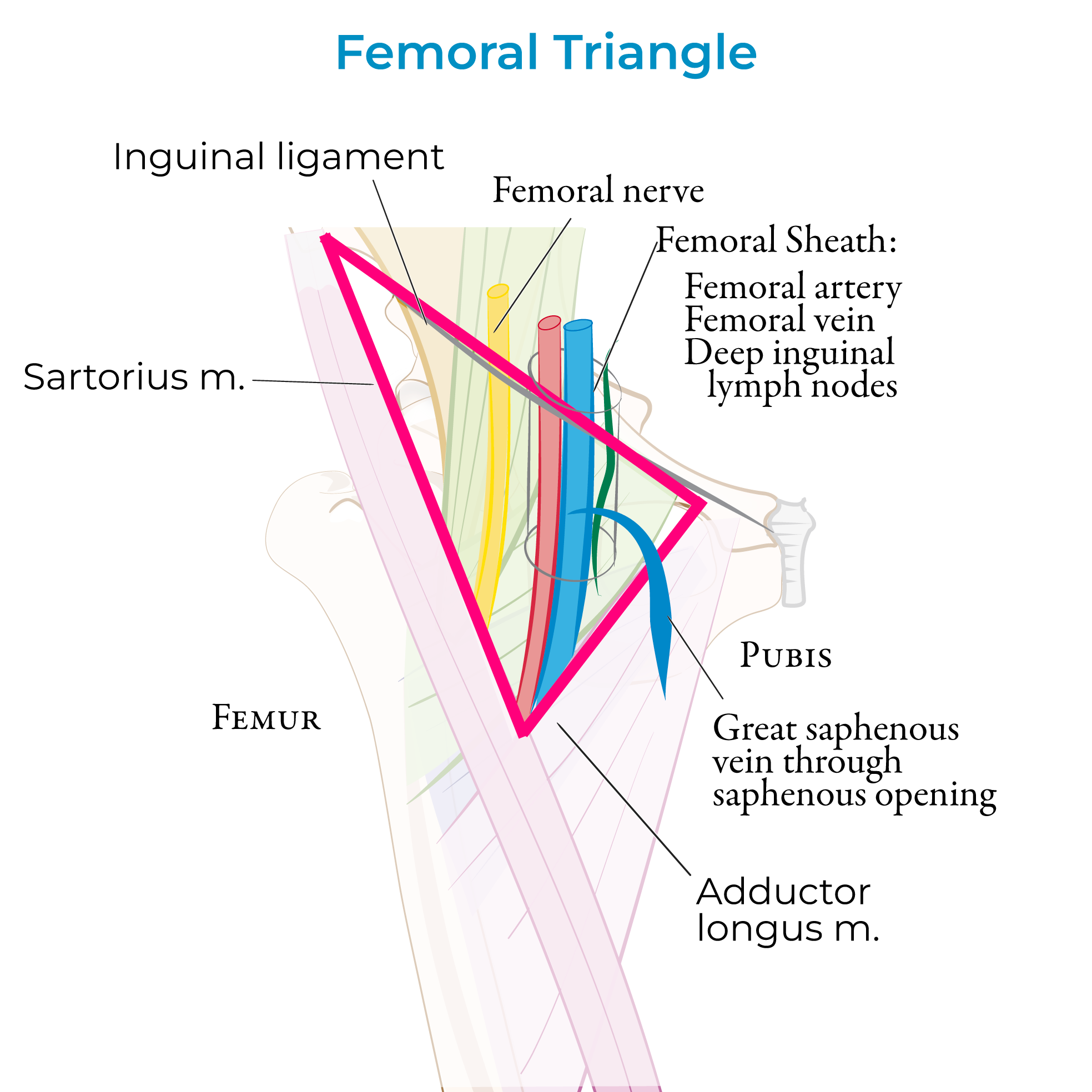
The femoral triangle is a useful landmark in the groin area of the anterior thigh.
Femoral Triangle Boundaries
The inguinal ligament forms the superior boundary; it forms the base of the triangle.
The lateral border of adductor longus forms the medial border.
Sartorius forms the lateral border of the triangle; the apex is formed by the crossing of sartorius over adductor longus.
The floor of the triangle comprises the muscles iliopsoas and pectineus.
The roof of the triangle is formed by the fascia lata of the thigh (along with the cribriform fascia, subcutaneous tissues, and skin of the thigh). The fascia lata comprises a thick band of connective tissue that envelops the muscles of the thigh.
Contents of the Femoral Triangle
Neurovascular and lymphatic structures pass through the space deep to the inguinal ligament between the pelvis and the thigh; this space is called the retro-inguinal space.
The vessels bisect the femoral triangle on their way to the adductor canal to traverse the lower thigh.
Mnemonic, from lateral to medial
N - Femoral Nerve and terminal branches.
A - Femoral Artery and its branches.
V - Femoral Vein
E - Empty space (the femoral canal – see notes below)
L - Deep Lymph nodes
Femoral Sheath:
The femoral sheath is a 3-4 cm long fascial tube derived from transversalis and iliac fascia. The sheath envelops the femoral artery and vein and their branches, as well as the deep inguinal lymph nodes.
The fascial sheath itself is divided into compartments:
Lateral, containing the femoral artery.
Intermediate, containing the femoral vein.
Medial, which houses the femoral canal with lymph vessels.
Great Saphenous Vein & Clinical Correlations
The great saphenous vein, which is the long superficial vein that drains the lower extremity, passes through the saphenous opening of the fascia lata to drain into the femoral vein within the femoral triangle.
The great saphenous vein is often used in arterial bypass operations (coronary artery and peripheral), due to its large size and relatively easy access.
In an emergency setting, the great saphenous vein can be used for venous cutdown, in which the vein is exposed and a cannula or catheter is inserted into the vessel.
Femoral Hernias
At the proximal end of the femoral canal, we'll find the femoral ring - this is a clinically relevant area because femoral hernias occur when abdominal tissues, such as the intestines, protrude through the femoral ring to enter the femoral canal.
Femoral hernias are caused by straining that increases intra-abdominal pressure, as when coughing, heavy lifting, defecating or urinating, pregnancy and childbirth, etc.
Femoral hernias are rare overall but require surgical repair due to their high rate of bowel obstruction and ischemia.
Femoral Artery Catheterization
The femoral artery is a common site of catheterization to measure cardiac blood pressure or oxygen levels, or to perform angioplasty or stent placement in the heart.
Femoral Vein Catheterization
Femoral vein catheters are used to administer medications or continuously measure blood pressure; because of its easy access, it is a preferred site in emergency settings.