The common iliac artery descends to the pelvis, where it splits to form the internal and external iliac arteries.
When the external iliac artery passes deep to the inguinal ligament, it becomes the femoral artery.
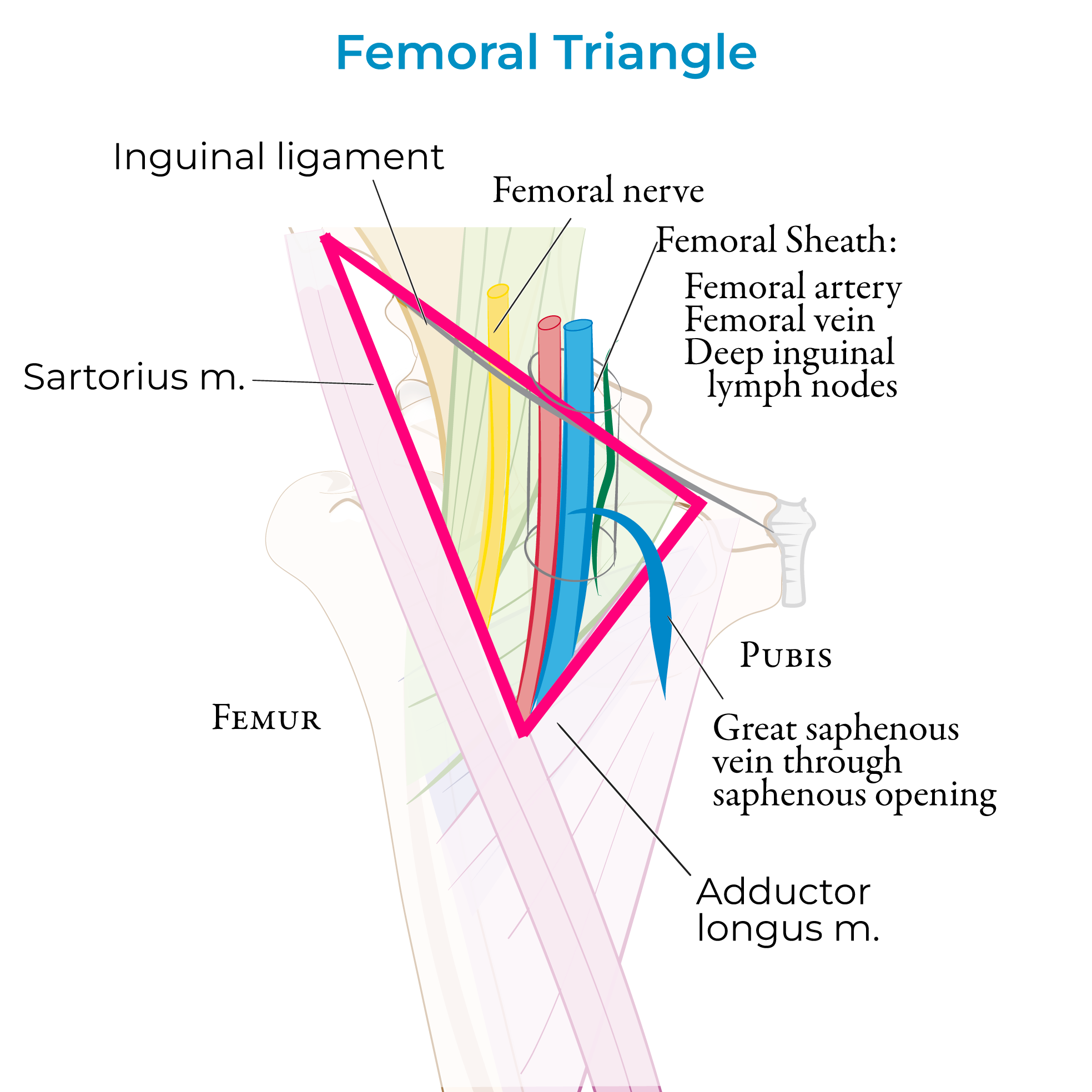
The femoral artery travels along the anterior thigh until it moves posteriorly through the adductor hiatus in the medial compartment.

The femoral artery supplies the anterior and medial thigh.
The deep artery of the thigh (aka, deep femoral artery or profunda femoris artery) branches laterally from the femoral artery.
Branches of the deep artery of the thigh:
- The lateral circumflex artery passes deep to sartorius and rectus femoris and gives rise to ascending, transverse, and descending branches; notice that the descending branch is long, and will contribute branches to the anastomoses around the knee.
- The medial circumflex artery travels medially and posteriorly (wrapping around the iliopsoas tendon) to reach the gluteal region, where it gives off branches that anastomose with the transverse branch of the lateral circumflex artery.
The branches of the circumflex arteries supply the femoral head and neck and the nearby muscles.
The deep artery of the thigh also gives off 3 or 4 perforating branches that pass through the adductor magnus muscle and around the femur to supply the muscles of the medial, posterior, and lateral thigh.
When the femoral artery passes posteriorly through the adductor hiatus, it becomes the popliteal artery.
In the leg, the popliteal artery splits to form the anterior and posterior tibial arteries.
The anterior artery passes through the interosseous membrane between the tibia and fibula and descends to the foot,
traveling between the tibialis anterior and extensor digitorum longus muscles.
At the ankle, the anterior tibial artery becomes the dorsalis pedis artery, which gives rise to the first dorsal metatarsal artery and the deep plantar artery. As its name suggests, the deep plantar artery joins the lateral plantar artery to complete the deep plantar arch.
The posterior tibial artery descends through the posterior compartment of the leg; it passes behind the medial malleolus and terminates bifurcates to form the medial and lateral plantar arteries.
The fibular artery is a branch of the posterior tibial artery; it travels within the posterior compartment of the leg and provides perforating branches that supply the lateral compartment of the leg.
The popliteal artery as it exits the adductor hiatus and travels in the posterior knee between the gastrocnemius and popliteus muscles.
At the inferior border of popliteus, the popliteal artery splits to give rise to the anterior and posterior tibial arteries (alternatively, the popliteal artery becomes the posterior tibial artery, with the anterior tibial artery branching from the posterior artery -- you can reword this if you find it too messy).
The anterior tibial artery passes through the interosseous membrane to descend in the anterior compartment of the leg.
The posterior tibial artery descends with the tibial nerve over the tibialis posterior and flexor digitorum longus muscles.

At the ankle, it passes through the tarsal tunnel and enters the foot, where it gives rise to the medial and lateral plantar arteries.
The lateral plantar artery, as we mentioned earlier, is joined by the dorsalis pedis artery to form the deep plantar arch.
The fibular artery, which is the largest branch of the posterior tibial artery, descends through the posterior compartment (often within the flexor hallucis longus muscle). The fibular artery gives rise to muscular, perforating, and nutrient branches. At the ankle, it terminates as calcaneal branches.


