
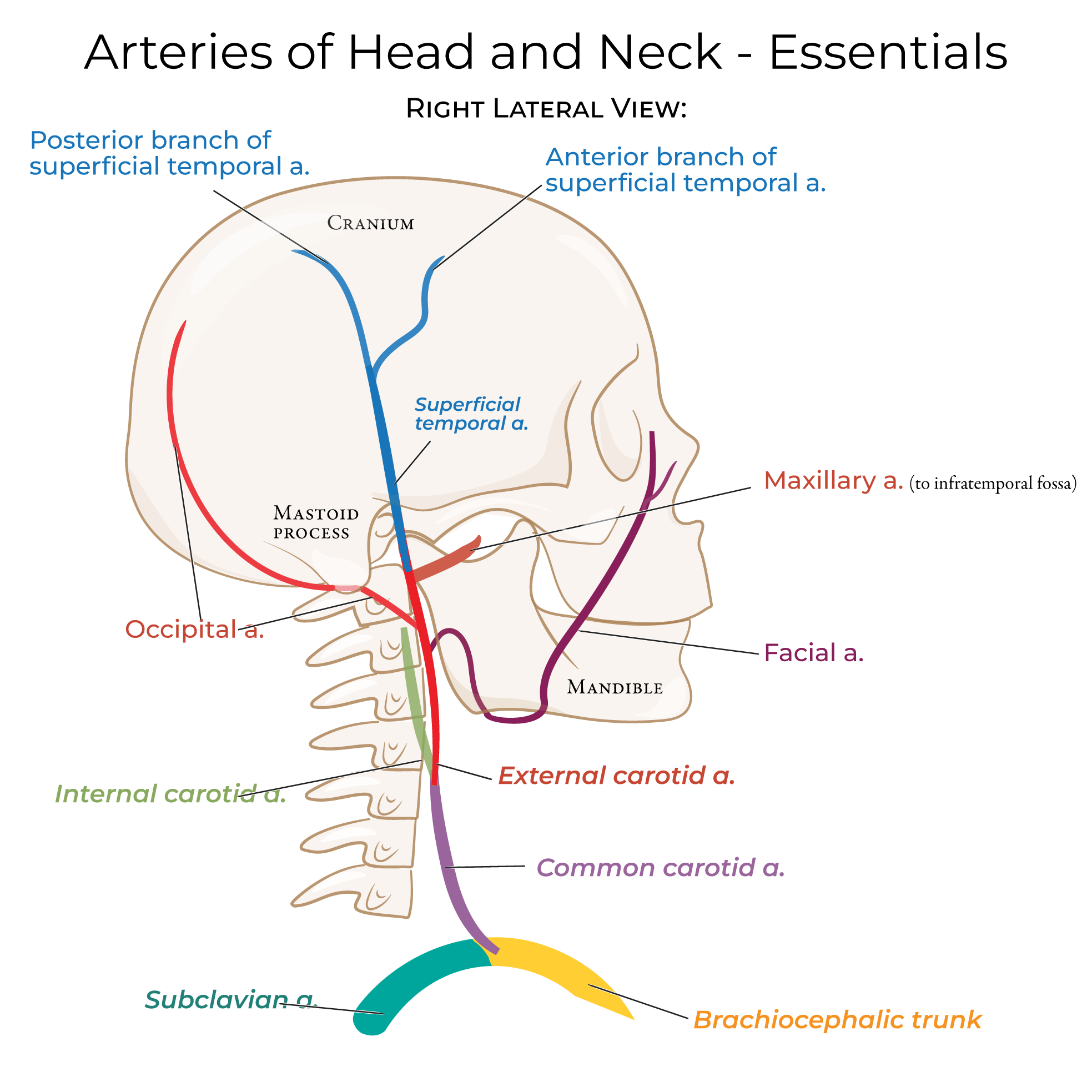


Arteries - Head & Neck
Arteries of the Head and Neck

Brachiocephalic trunk
First branch of arch of aorta.
Bifurcates to form the right common carotid and Right subclavian arteries.
Left common carotid artery
Second branch of arch of aorta
Left subclavian artery
Third branch of arch of aorta
Common carotid artery
Common carotid artery bifurcates:
- Internal carotid artery enters the skull via the carotid canal (and is addressed with the blood supply of the brain)
- External carotid artery travels posterior to the mandible, then divides into its two terminal branches.
Branches of External Carotid Artery:
Superior thyroid artery travels to the superior portion of the thyroid gland;
Ascending pharyngeal artery arises from the posterior aspect of the external carotid artery and travels superiorly (aka, ascends) through the neck to supply structures related to the throat;
Lingual artery arises just superior to the ascending pharyngeal artery, and travels deep to the mandible to reach its target tissues in the mouth.
Facial artery courses deep to the mandible initially, but then emerges to travel superiorly over the face towards the orbits.
Facial artery has several branches:
- Inferior labial and superior labial arteries, which travel to the upper and lower lips.
- Lateral nasal artery, which travels to the lateral and dorsal sides of the nose.
Subclavian artery
Four branches:
Vertebral artery passes through the transverse foramina of cervical vertebrae 6 through 1 (it passes over the transverse foramen of C7), and into the cranium via the foramen magnum (this vessel can be subdivided into cervical, vertebral, suboccipital, and cranial portions, according to region).
Thyrocervical trunk gives rise to three branches (the inferior thyroid, transverse cervical, and suprascapular arteries).
Internal thoracic artery
Descends within the anterior thorax, where it gives rise to the anterior intercostal arteries.
Costocervical trunk
Gives rise to two branches (the **deep cervical and supreme (aka, superior) intercostal arteries).
Carotid body
- Lies at bifurcation of common carotid artery
- Monitors blood oxygen levels
Carotid sinus
- Dilation in internal carotid artery
- Monitors blood pressure
Clinical Correlations
- Occlusion of the proximal subclavian artery can cause subclavian steal syndrome
- The subclavian artery "steals" blood flow from the vertebral artery to supply the arm.
- Decreased blood-flow through the vertebral artery, which supplies the posterior circulation of the brain: the brainstem and posterior brain, can result in a myriad of symptoms, including syncope.
- Blockage of the carotid arteries can obstruct blood flow and lead to stroke, because the internal carotid arteries supply the anterior blood-flow circulation to the brain.
- Learn more about atherosclerosis.
- Moyamoya, a progressive cerebrovascular disorder that primarily affects children, causes narrowing of the internal carotid arteries and ischemic attack.
- Its name (which means, "puff of smoke" in Japanese) is derived from the tangle of tiny vessels that form in the brain to compensate for blockages.
- Surgical fixes of internal carotid artery blockage include EC-IC (extracranial-intracranial) bypass, in which the superficial temporal artery is rerouted through a hole in the cranium and connected to the internal vasculature, which opens up blood flow to the brain.