Here we'll learn about the wrist joint and related ligaments; for information about wrist tendons, please see our tutorials on forearm muscles and
upper limb joint injuries..
The wrist joint proper, aka the radiocarpal joint, comprises the concave end of the radius, the articular disc, and the convex surfaces of three proximal carpal bones. As we'll see, there is a direct connection between radius and the scaphoid and lunate, and an indirect connection to the triquetrum via the articular disc.
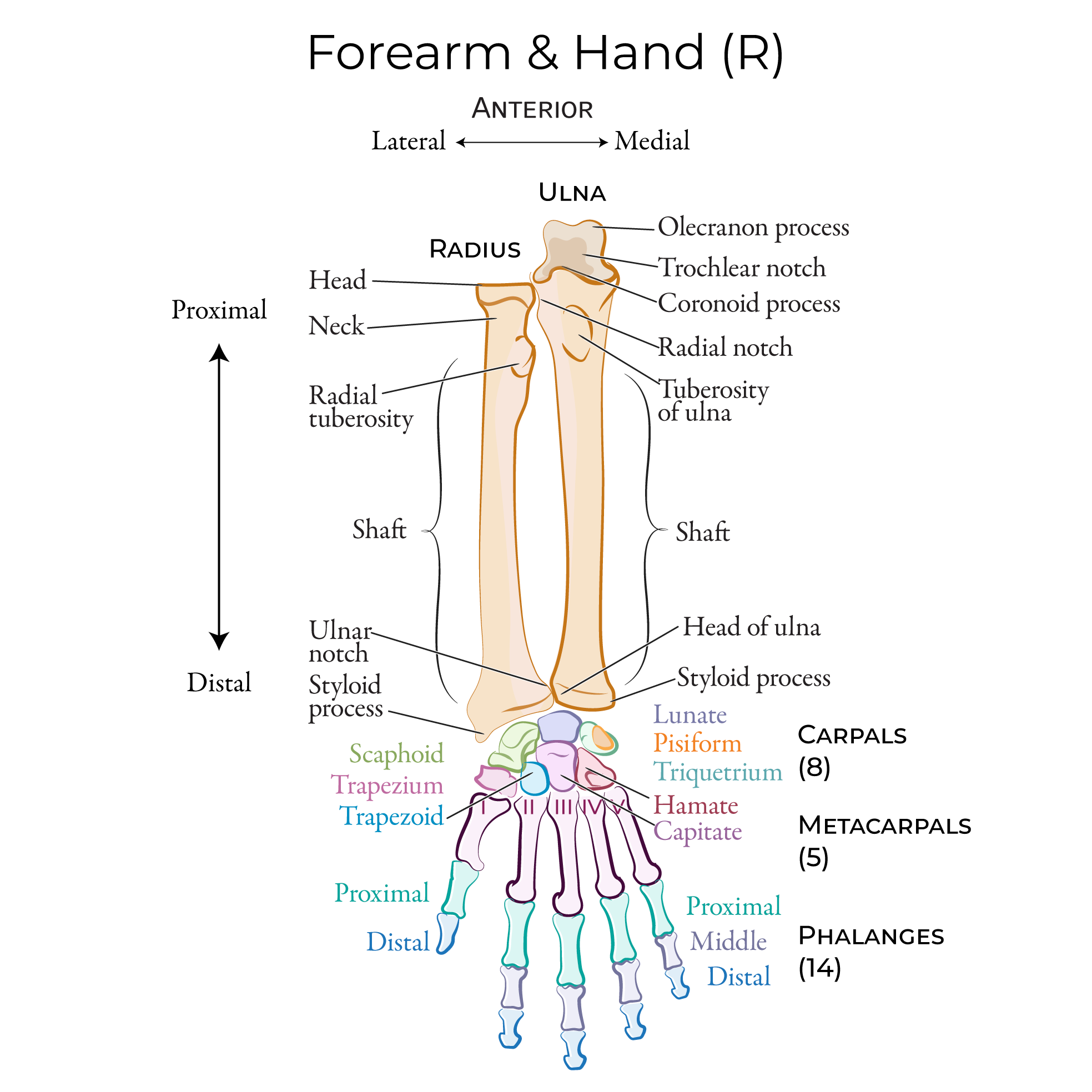
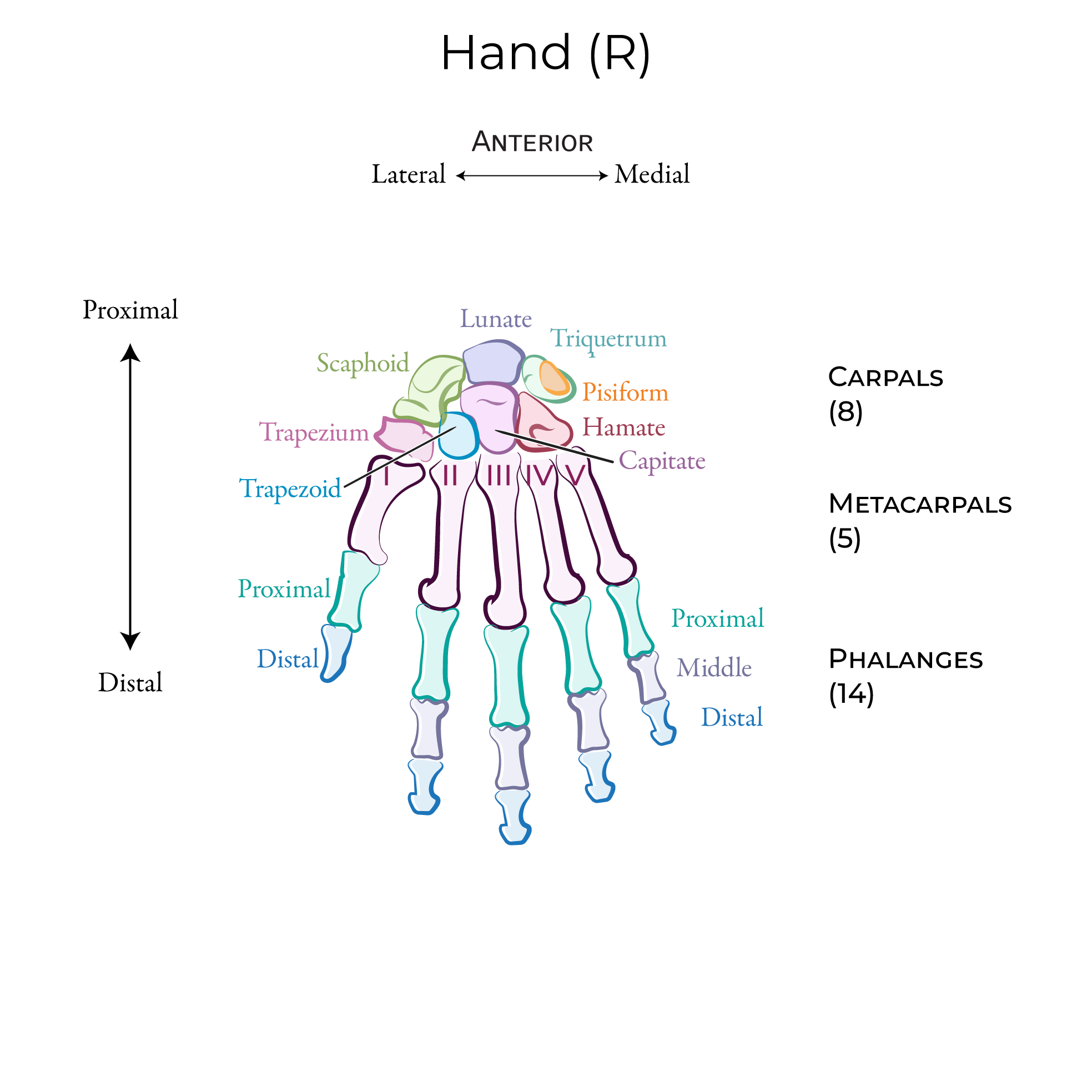
It is a synovial joint with high mobility; it allows for extension, flexion, adduction, and abduction of the wrist. As a consequence of its high mobility, injury is common.
The TFCC, aka the triangular fibrocartilage complex, is a stabilizing structure on the medial (ulnar) side of the wrist. It transfers forces from the lunate and triquetrum, to the ulnar head. The TFCC comprises the articular disc, dorsal and palmar (aka volar) radioulnar ligaments, meniscus homologue, the ulnar collateral ligament, and the extensor carpi ulnaris tendon sheath.
Innervation:
Anterior interosseous nerve from median nerve; posterior interosseous nerve from radial nerve, deep and dorsal branches of ulnar nerve.
Blood supply:
Branches of dorsal and palmar carpal arches.
Let's begin our diagram with a coronal section of wrist from the dorsal side so we can see key elements of the radiocarpal joint.
Ulna, medially and the radius, laterally.
8 carpals: in the proximal row, from medial to lateral, show the pisiform, triquetrum, lunate, and scaphoid bones. In the distal row, show the hamate, capitate, trapezoid, and trapezium.
The articular disc, which is roughly triangular in shape, separates the ulna from the carpals.
The meniscus homologue of the wrist is also on the ulnar side of the wrist.
Both of these structures contribute to the TFCC.
The radiocarpal wrist joint between the radius and the proximal carpals.
The mid carpal joint is between the proximal and distal carpals.
The interosseous intercarpal ligaments are between the carpal bones. They connect adjacent carpals via short fibrous bands. Though we won't go into detail here, they are named after the bones which they connect (for example, scapholunate, lunotriquetral).
The dorsal radiocarpal ligament as it extends from the dorsal radius to the lunate and triquetrum via deep and superficial attachments. The dorsal radiocarpal ligament limits full flexion of the wrist joint.
Distal to this lies the dorsal intercarpal ligament; it extends from the triquetrum to the groove of the scaphoid and the lunate bones; it often also attaches to the trapezium. The dorsal intercarpal ligament stabilizes the carpal bones.
Two ligaments that aren't part of the wrist joint proper:
The dorsal radioulnar ligament and the dorsal radial metaphyseal arcuate ligament, which stabilize the distal radioulnar joint. The dorsal radioulnar ligament is part of the TFCC.
The radial collateral ligament extends from the radial styloid process to the scaphoid and trapezium; this ligament prevents excessive ulnar deviation of hand.
The ulnar collateral ligament, which extends from the ulnar styloid process to the triquetrum and pisiform; this ligament prevents excessive radial deviation.
The palmar radiocarpal ligament extends from the radius and inserts on the lunate, capitate, and scaphoid bones.
We can further divide it into 4 parts: radioscaphocapitate ligament, long radiolunate ligament, radioscapholunate ligament, short radiolunate ligament.
Be aware that the radioscapulunate ligament provides proprioception and therefore may be categorized as a neurovascular structure.
The palmar radiocarpal ligament prevents overextension of the wrist.
The palmar radioulnar ligament binds the distal radius and ulna together.
The palmar ulnocarpal ligament extends from the distal ulna to the capitate, lunate, triquetrum, and pisiform bones. Like its radial counterpart, this ligament can be further divided, but its fibers tend to blend together: the ulnocapitate, ulnolunate, ulnotriquetral, and ulnopisiform ligaments.
Clinical Correlations: Wrist Sprains
Wrist sprains, in which the ligaments are partially or completely torn are commonly associated with a Fall On an Outstretched Hand (FOOSH).
Sprains to the ligaments of the TFCC cause pain on the ulnar side of the wrist.
Sprains to the scapholunate ligament are common causes of dorsal and radial-sided wrist pain.
Scapholunate ligament injury can lead to DISI deformity (dorsal intercalated segment instability) with widening of the scapholunate joint and dorsal tilting of the lunate carpal.