

Start your One-Week Free Trial
Already subscribed? Log in »

Hepatic Portal Veins
Here we will learn the veins that constitute the hepatic portal system; be aware that these patterns are highly variable.
The hepatic portal system transports blood from the stomach, spleen, pancreas, and small and large intestines to the liver for filtration. This distinct circulatory pathway exists to allow the liver to metabolize nutrients and toxins from blood that leaves the digestive organs.
Don’t confuse the hepatic portal veins with the hepatic veins, which transport blood away from the liver.
We show the liver and gallbladder, the stomach, small intestine, and large intestine; we’ve cut out part of the transverse colon to show vessels that run deep to it. To the left of the stomach, draw the spleen.
Hepatic portal vein and major tributaries of the portal system:
Now we’ll fill in the smaller tributaries of the hepatic portal system.
Portal hypertension occurs when the hepatic portal vein becomes blocked. As a result, portal blood pressure increases and varices can form; these thin-walled, engorged vessels are susceptible to trauma, and rupture can lead to fatal hemorrhaging.
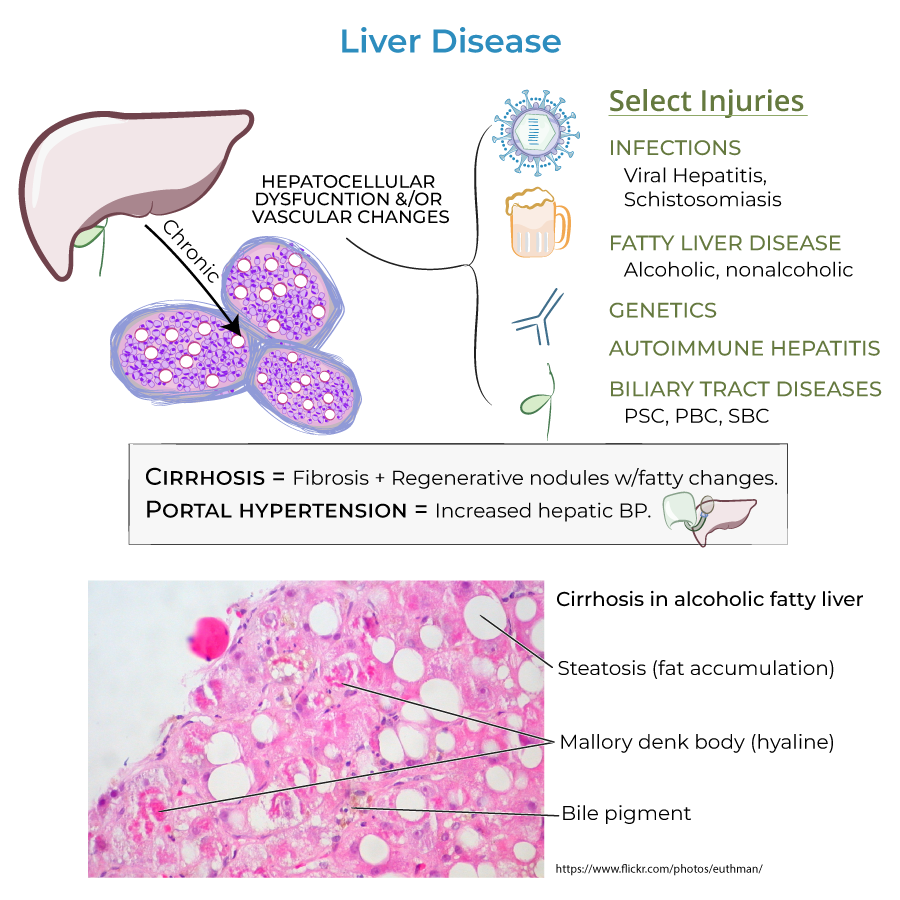 Cirrhosis is an important cause of portal hypertension; this is a condition in which scar tissue replaces healthy liver tissue.
Overview
Chair Schematic of the portal system
- The hepatic portal vein, which carries blood to the liver, forms the "back" of the chair.
- Two major tributaries:
Hepatic Portal System - Main Vessels
- The splenic, inferior mesenteric, and superior mesenteric veins.
Hepatic Portal System - Details
Hepatic Portal Vein - Direct Tributaries
- Right and left gastric veins anastomose along the lesser curvature of the stomach; they drain blood from the stomach and esophagus. The left gastric vein occasionally drains into the splenic vein, instead.
- The cystic vein drains blood from the gallbladder.
- The superior pancreaticoduodenal vein drains blood from the pancreas and duodenum. This vein may take a less direct route through the gastroduodenal or right gastro-omental vein.
Splenic Vein Tributaries
In addition to draining the inferior mesenteric vein, ithe splenic also receives blood from the:
- Short gastric veins
- Left gastro-omental vein (aka gastroepiploic vein)
- Pancreatic veins (which we’ve omitted for simplicity).
Inferior Mesenteric Vein Tributaries
The IMV drains blood from the distal colon and rectum via:
- Left colic vein
- Sigmoid vein
- Superior rectal veins
Superior Mesenteric Vein Tributaries
The SMV receives blood from the distal stomach, small intestine, proximal colon, and greater omentum via the:
- Right gastro-omental vein, which drains blood from the greater curvature of the stomach.
- Intestinal (jejunal and ileal) vein
- Ileocolic vein
- Right vein
- Middle vein
- Inferior pancreaticoduodenal vein (not present in our diagram)
Portal Hypertension
Cirrhosis is an important cause of portal hypertension; this is a condition in which scar tissue replaces healthy liver tissue.