

Start your One-Week Free Trial
Already subscribed? Log in »

Soft Palate
Here we’ll learn about the 5 paired muscles of the soft palate, which is a soft-tissue structure that continues from the posterior aspect of the hard palate.
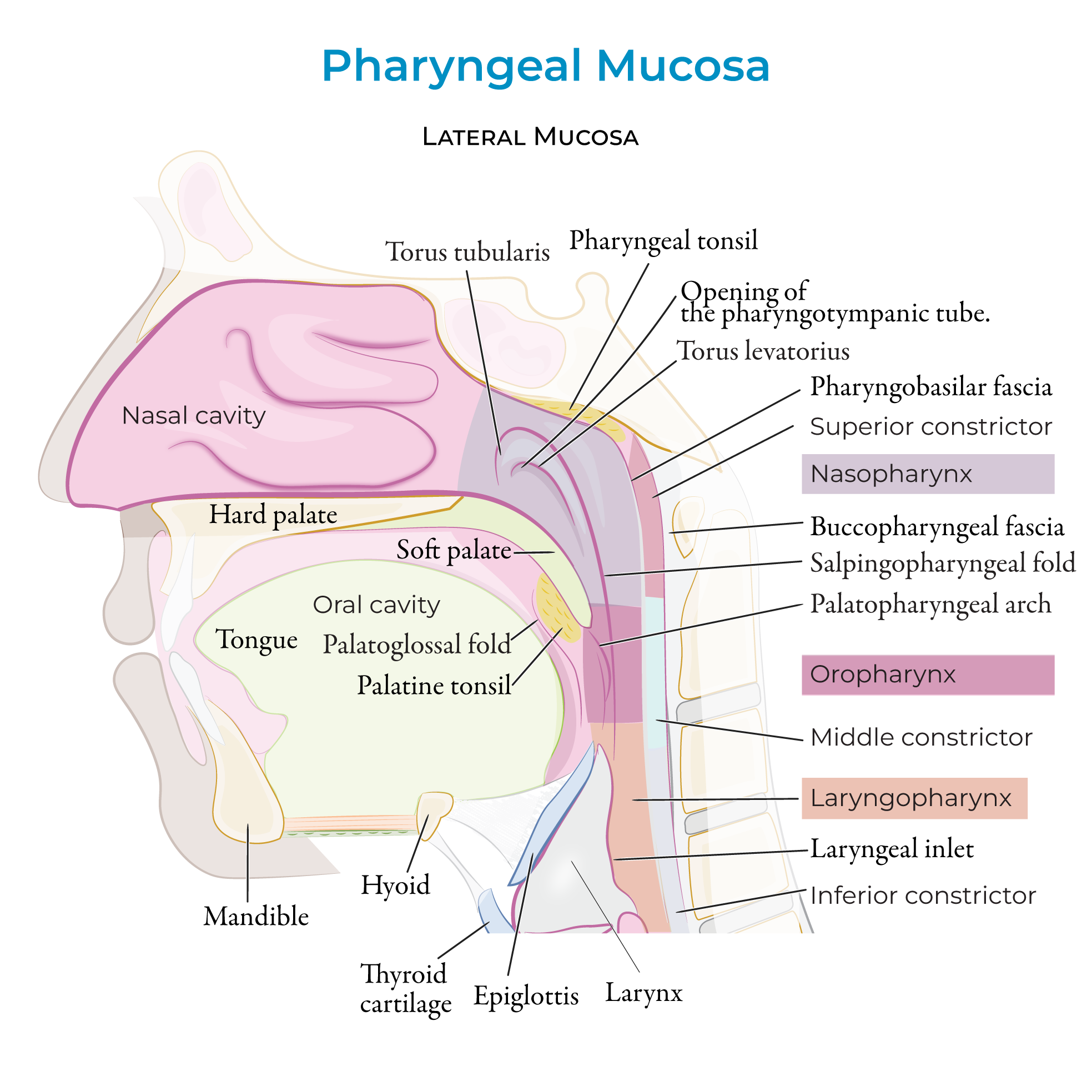
The soft palate, aka velum, acts as a valve that can be depressed to close off the oropharyngeal isthmus (the opening between the oral cavity and the oropharynx) or elevated to close off the oropharynx and nasopharynx during speech and swallowing.
 Palatoglossus depresses the palate and elevates the back of the tongue; we can infer this from its sling-like position under the root of the tongue.
Palatopharyngeus:
Arises from the superior surface of the palatine aponeurosis and passes posteriorly and laterally to descend along the pharyngeal wall.
Palatoglossus depresses the palate and elevates the back of the tongue; we can infer this from its sling-like position under the root of the tongue.
Palatopharyngeus:
Arises from the superior surface of the palatine aponeurosis and passes posteriorly and laterally to descend along the pharyngeal wall.
 Palatopharyngeus depresses the soft palate and elevates and constricts the pharynx.
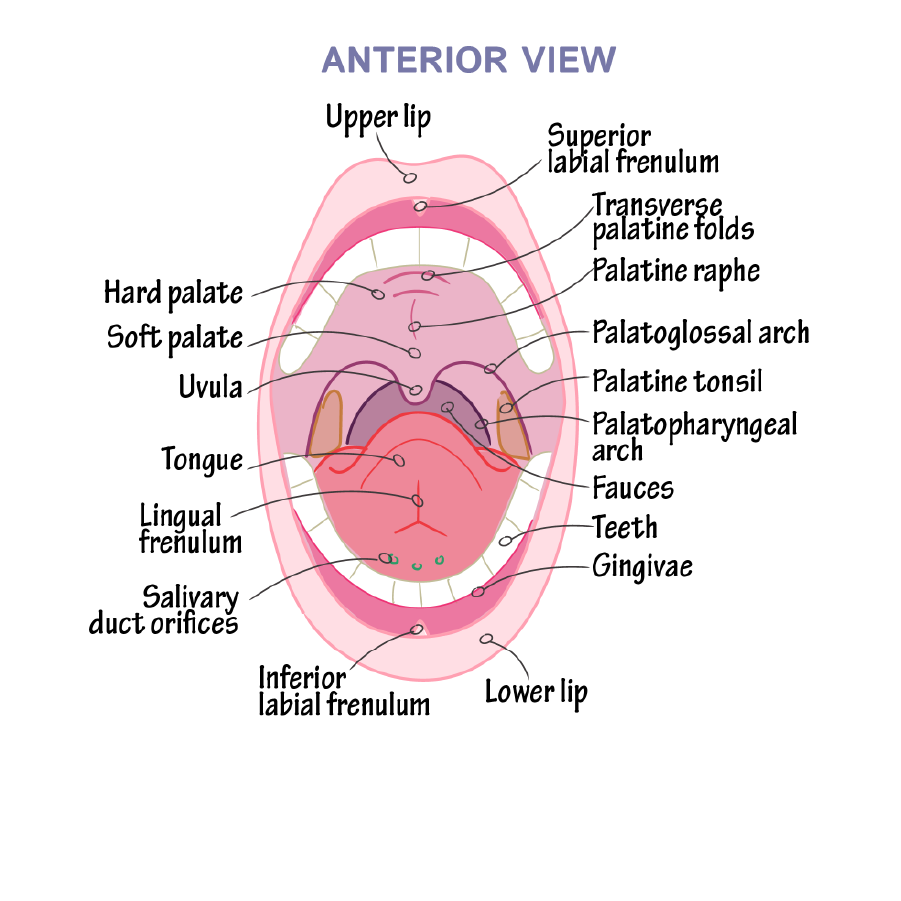
When we’re looking in a patient’s mouth, the palatopharyngeal muscles underlie the palatopharyngeal arches (aka posterior faucial pillars). These arches are medial and posterior to the palatoglossal arches; the palatine tonsil is between the two arches.
Notice that both palatopharyngeus and palatoglossus depress the soft palate and therefore close off the oropharyngeal isthmus, whereas the levator veli palatini elevates the soft palate and closes of communication between the oropharynx and nasopharynx.
Musculus uvulae:
Arises from the posterior nasal spine and passes over the palatine aponeurosis and inserts into the mucosa of the uvula. This muscle elevates and retracts the uvula, which aids the levator veli palatini muscle in elevating the soft palate.
Palatopharyngeus depresses the soft palate and elevates and constricts the pharynx.
When we’re looking in a patient’s mouth, the palatopharyngeal muscles underlie the palatopharyngeal arches (aka posterior faucial pillars). These arches are medial and posterior to the palatoglossal arches; the palatine tonsil is between the two arches.
Notice that both palatopharyngeus and palatoglossus depress the soft palate and therefore close off the oropharyngeal isthmus, whereas the levator veli palatini elevates the soft palate and closes of communication between the oropharynx and nasopharynx.
Musculus uvulae:
Arises from the posterior nasal spine and passes over the palatine aponeurosis and inserts into the mucosa of the uvula. This muscle elevates and retracts the uvula, which aids the levator veli palatini muscle in elevating the soft palate.
Muscles of the Soft Palate
Anterior View
We show the tongue and the pterygoid hamuli, which are hook-like extensions of the medial pterygoid plates of the sphenoid bone.
Tensor veli palatini muscle has two parts:
The muscular, vertically oriented part descends along the lateral surface of the medial pterygoid plate and gives rise to a tendon that wraps under the pterygoid hamuli.
From here, the tendinous portion expands to form a fan-like fibrous aponeurosis. The pterygoid hamulus acts as a pulley: when the vertical portion of tensor veli palatini contracts, it pulls horizontally on the aponeurosis.
This palatine aponeurosis comprises a significant portion of the soft palate and provides attachment points for other soft palate muscles.
Tensor veli palatini tenses the soft palate and opens the pharyngotympanic (aka Eustachian or auditory tube) when we yawn or swallow. It is innervated by the mandibular branch of Cranial Nerve V (specifically the nerve to medial pterygoid).
Levator veli palatini:
Arises from the base of the skull and descends medially to insert on the superior surface of the palatine aponeurosis (specifically, it arises from the petrous part of the temporal bone; some fibers also arise from the pharyngotympanic tube).
Levator veli palatini elevates the soft palate towards the posterior pharyngeal wall, which closes off the oral cavity from the nasal cavity; this prevents foods and liquids from entering the nose during swallowing.
Levator veli palatini and the rest of the muscles of the soft palate are innervated by CN X via the pharyngeal plexus.
Palatoglossus (aka glossopalatine):
Arises from the inferior surface of the palatine aponeurosis and passes inferiorly and anteriorly along the lateral sides of the tongue.
When we’re looking in a patient’s oral cavity, this muscle underlies their palatoglossal arches (aka anterior faucial pillars), which comprise the borders of the oropharyngeal isthmus.
Palatoglossus depresses the palate and elevates the back of the tongue; we can infer this from its sling-like position under the root of the tongue.
Palatopharyngeus:
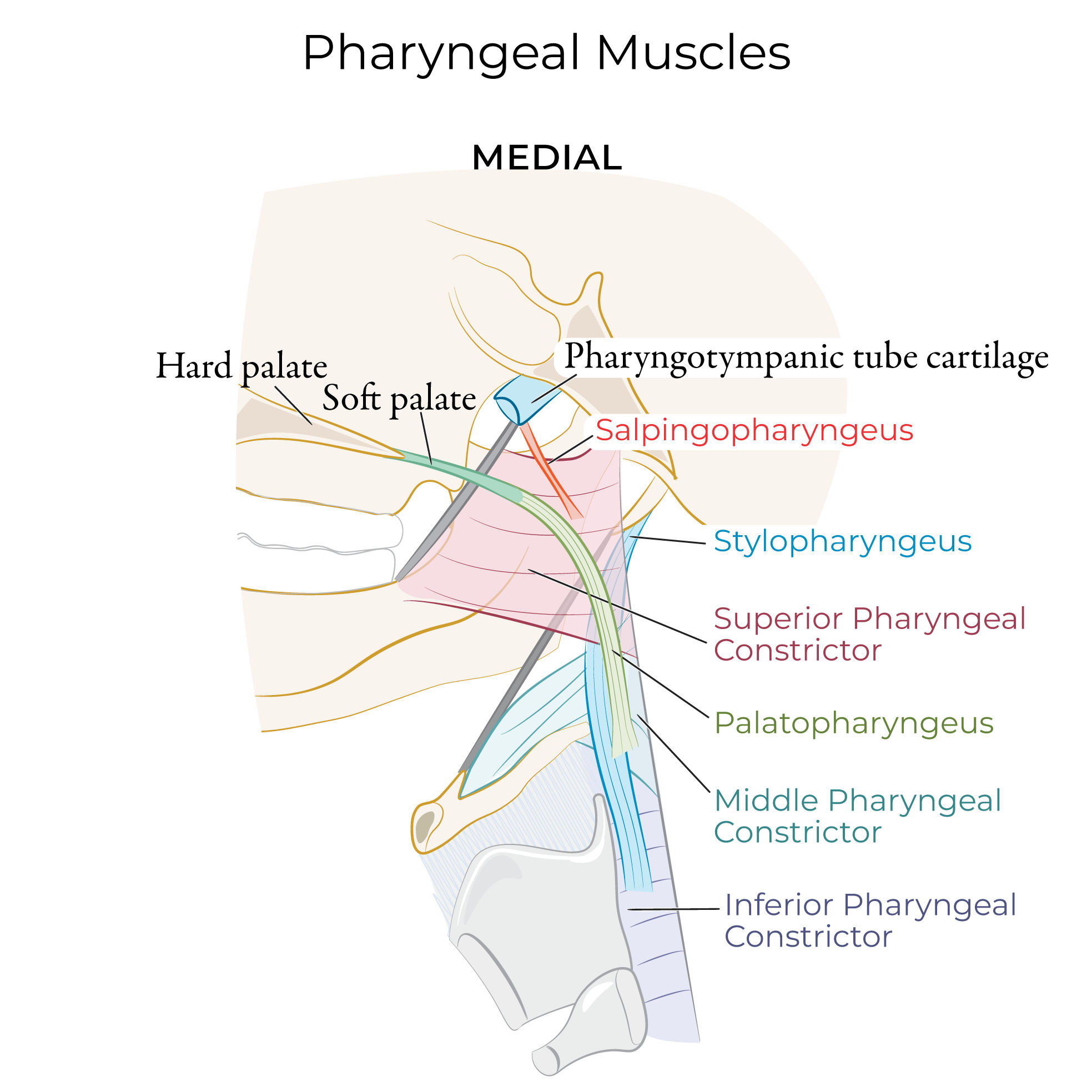
Arises from the superior surface of the palatine aponeurosis and passes posteriorly and laterally to descend along the pharyngeal wall.
Palatopharyngeus depresses the soft palate and elevates and constricts the pharynx.
When we’re looking in a patient’s mouth, the palatopharyngeal muscles underlie the palatopharyngeal arches (aka posterior faucial pillars). These arches are medial and posterior to the palatoglossal arches; the palatine tonsil is between the two arches.
Notice that both palatopharyngeus and palatoglossus depress the soft palate and therefore close off the oropharyngeal isthmus, whereas the levator veli palatini elevates the soft palate and closes of communication between the oropharynx and nasopharynx.
Musculus uvulae:
Arises from the posterior nasal spine and passes over the palatine aponeurosis and inserts into the mucosa of the uvula. This muscle elevates and retracts the uvula, which aids the levator veli palatini muscle in elevating the soft palate.
Posterior View
Now, let’s re-draw these muscles in posterior view to better see the soft palate, itself.
We show the vertical portions of the tensor veli palatini muscles, and indicate that they wrap under the pterygoid hamuli to give rise to the palatine aponeurosis.
In this view, we can see the broad anterior portion of the aponeurosis and that it gives rise to a free posterior portion.
This aponeurosis contributes significantly to the mass of the soft palate.
The levator veli palatini arises laterally and meets at the midline to insert on the aponeurosis.
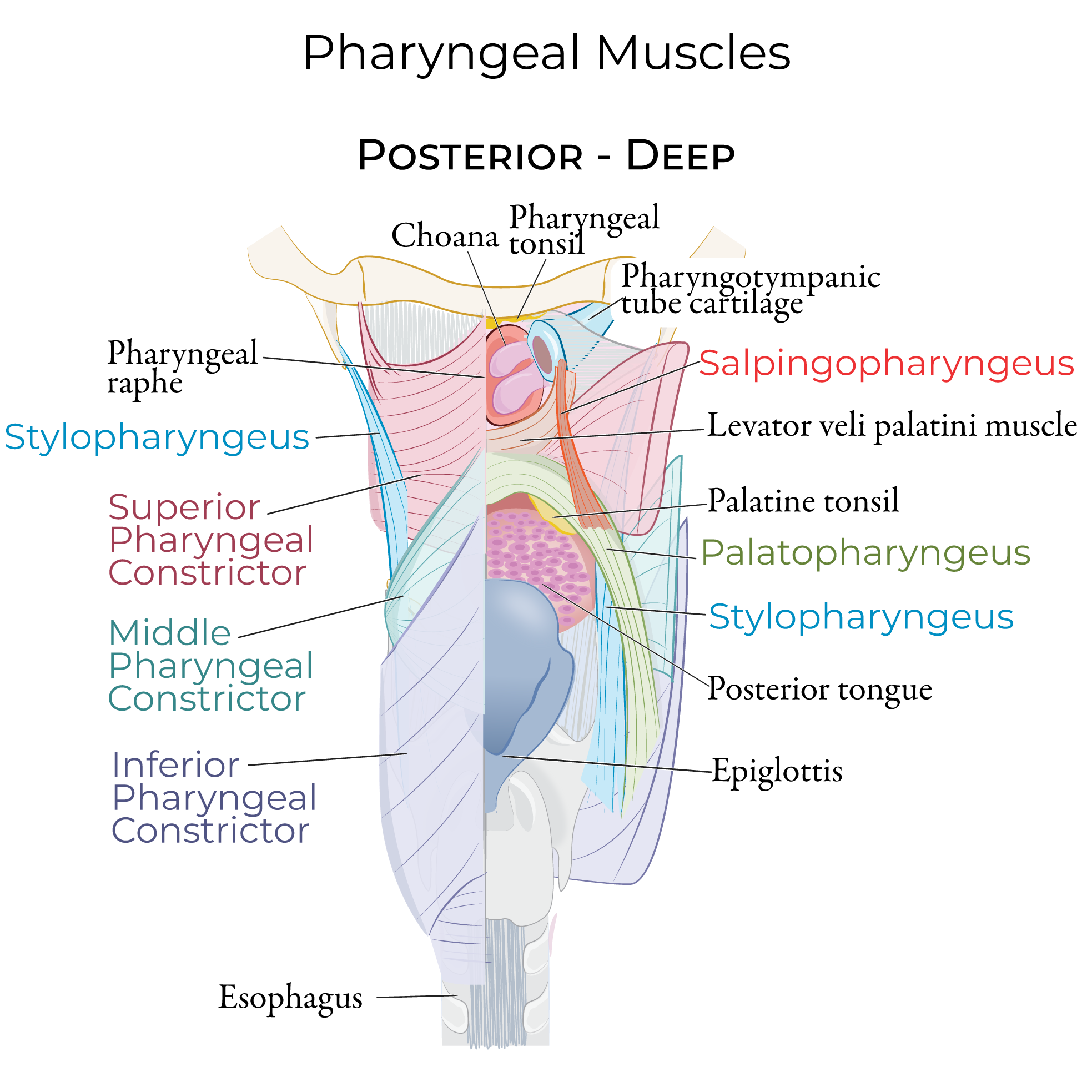
Palatopharyngeus arises as two pieces separated by levator veli palatini and passes posteriorly and laterally over the margins of the soft palate.
Palatoglossus arises from the inferior surface of the aponeurosis and inserts along the sides of the tongue.
Muscularis uvulae arises from the posterior edge of the hard palate and passes between the two sheets of palatopharyngeus before wrapping over the uvula.