
Start your One-Week Free Trial
Already subscribed? Log in »

Forearm - Anterior Muscles
Here we'll learn the deep and superficial muscles of the anterior forearm, which flex the wrist and digits. Most of the muscles we'll learn are innervated by the median and ulnar nerves of the brachial plexus.
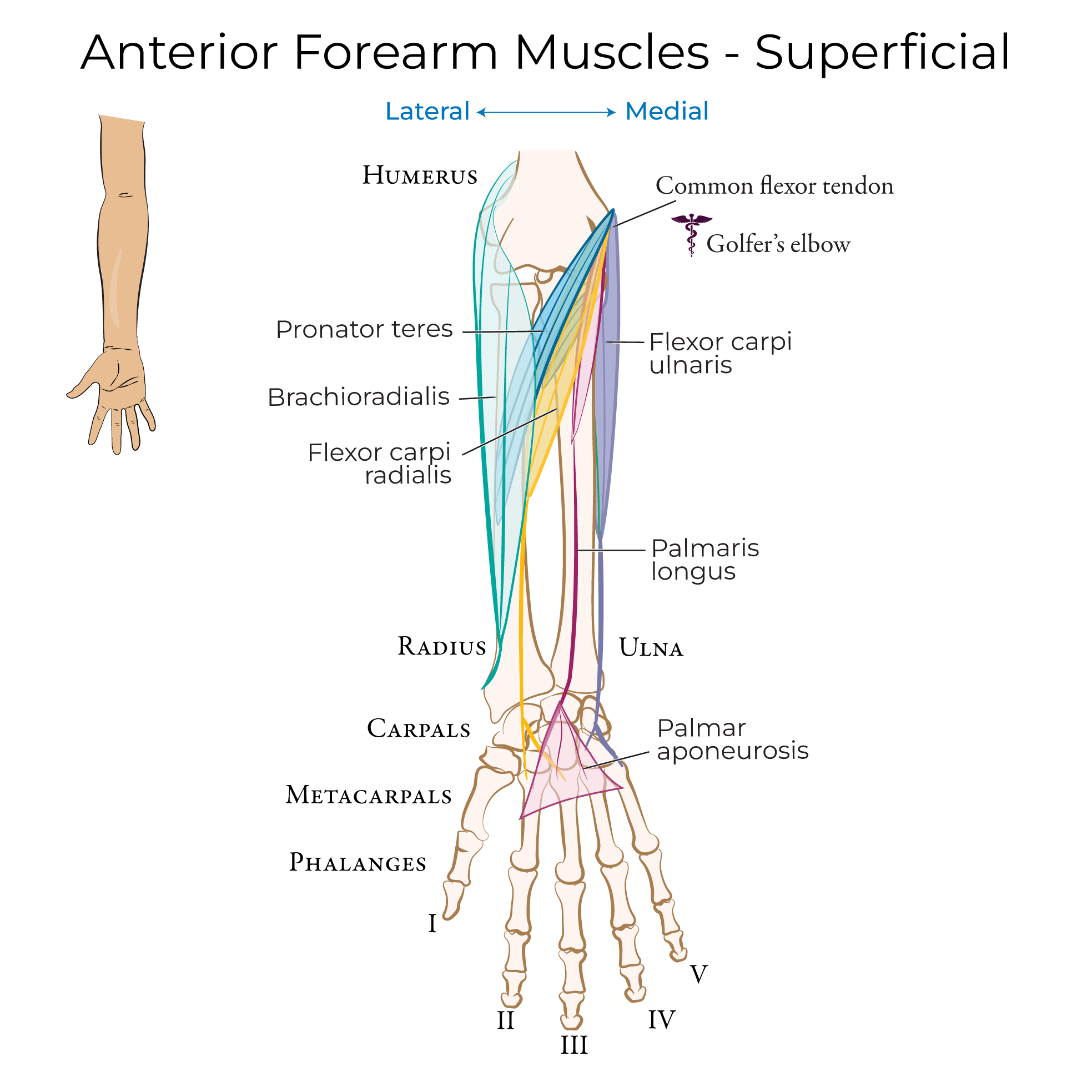
Muscles: Flexor carpi ulnaris, Palmaris longus, Flexor carpi radialis, Pronator teres, and Brachioradialis.
Be aware that, despite its anterior location and complimentary actions, brachioradialis is often considered a posterior-compartment muscle because of its origins and radial nerve innervation.
Muscles: Pronator quadratus, Flexor digitorum profundus, Flexor pollicis longus, and Flexor digitorum superficialis.
Superficial Layer
Common flexor tendon
Many of these muscles arise from the common flexor tendon on the medial epicondyle of the humerus.
Medial epicondylitis (aka, Golfer's elbow) results from inflammation of the common flexor tendon on the medial epicondyle of the humerus.
Flexor carpi ulnaris
Two origins and insertions:
- The humeral head arises from the common flexor tendon on the humerus, and the ulnar head arises from the posterior ulna and olecranon process.
- The two heads merge, and flexor carpi ulnaris inserts on the wrist: one tendon inserts on the base of metacarpal V and the other inserts on the pisiform and hook of the hamate.
- Because it crosses the wrist and inserts medially, flexor carpi ulnaris flexes and adducts the wrist.
Palmaris longus
- Arises from the common flexor tendon and inserts into the palmar aponeurosis.
- This muscle flexes the wrist.
Flexor carpi radialis
- Arises from the common flexor tendon and inserts into the second and third metacarpals.
- Because it crosses the wrist and inserts laterally, flexor carpi radialis flexes and abducts the wrist.
Pronator teres
- Two heads:
- Pronator teres flexes the forearm and pronates it.
Brachioradialis
- Arises on the lateral side of the humerus (on the supracondylar ridge) and inserts on the styloid process of the radius. It is a powerful flexor of the forearm.
Deep Layer
Pronator quadratus
- This is a quadrilateral-shaped muscle that arises from the distal ulna and inserts on the radius.
- As its name suggests, it pronates the forearm (turns the palms down).
Flexor digitorum profundus
- Arises from the ulna and interosseous membrane (the connective tissue between the radius and ulna) and gives rise to four long tendons that insert on the distal phalanges of digits 2-5.
- Because it crosses the wrist and the joints of the fingers, flexor digitorum profundus flexes the wrist and digits two through 5.
Flexor pollicis longus
- Arises from the radius and interosseus membrane and gives rise to a long tendon that inserts on the distal phalanx of digit 1. "Pollicis" refers to the thumb.
- Flexor pollicis longus flexes the digit 1.
Flexor digitorum superficialis
- Multiple points of origin: it arises from the medial epicondyle of the humerus, the coronoid process of the ulna, and from the oblique line of the radius.
- Like the deeper version, flexor digitorum superficialis gives rise to four tendons that split to insert on the sides of the middle phalanges of digits two through five.
- Notice that the split in the tendons for flexor digitorum superficialis provides space for the tendons of flexor digitorum profundus to pass through to the distal phalanges of the digits.
- Flexor digitorum superficialis flexes the wrist and digits two through five.
Flexor retinaculum and carpal tunnel syndrome
Flexor retinaculum
- A strap-like band of connective tissue called the flexor retinaculum crosses laterally over the tendons of the anterior forearm muscles at the wrist, forming the "carpal tunnel".
Carpal tunnel syndrome
- The median nerve also travels through the carpal tunnel; compression of the median nerve causes carpal tunnel syndrome.