

Start your One-Week Free Trial
Already subscribed? Log in »
Rotation of the Pancreatic & Biliary Ducts
Biliary and Pancreatic Duct Rotation
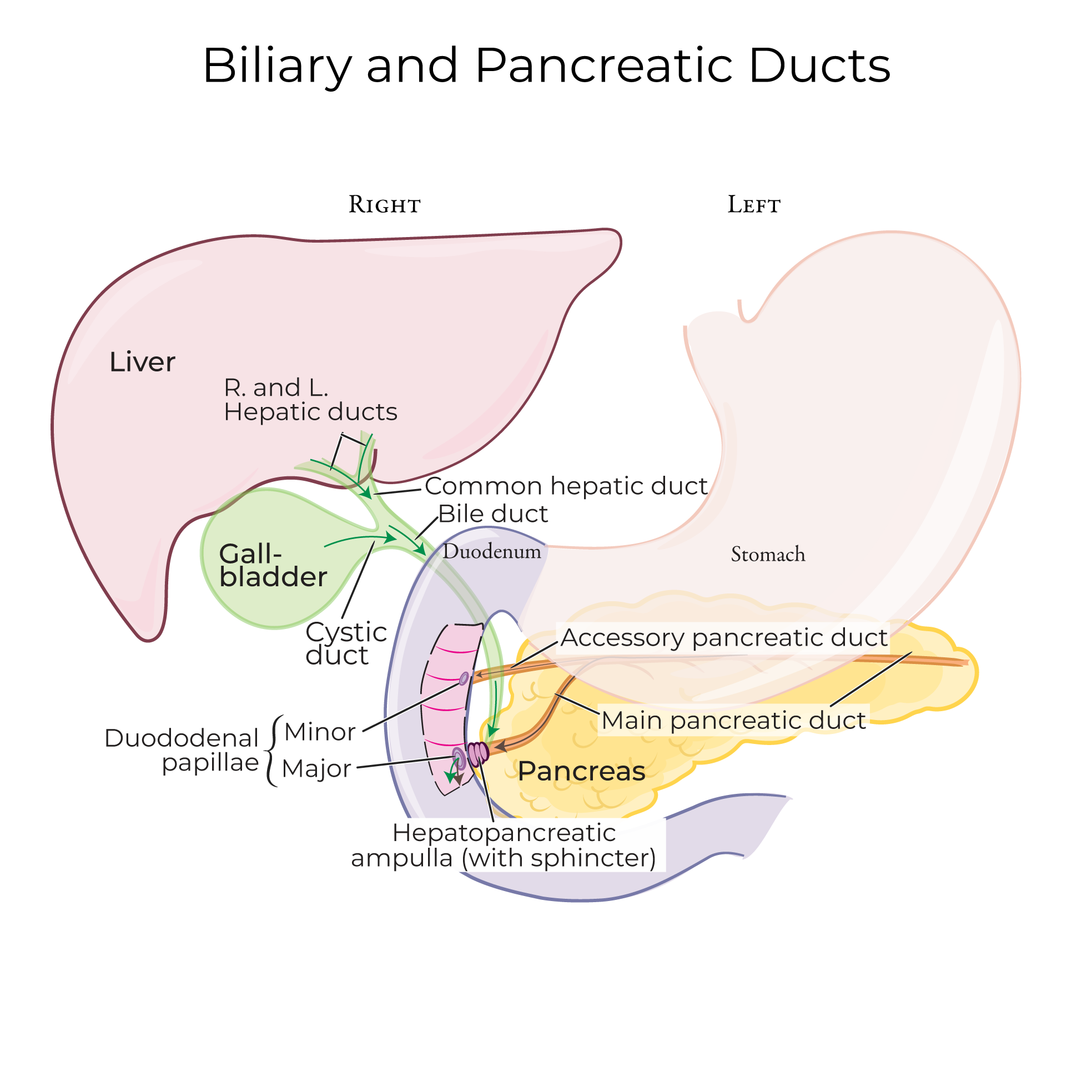 The fused pancreas nestles into the c-curve of the duodenum and extends towards the left side of the body.
The uncinate process is the portion derived from the ventral pancreatic bud.
The main and accessory pancreatic ducts, which drain smaller ducts and empty into the duodenum.
On the right side of the diagram, the liver drains into the hepatic duct, and the gallbladder drains into the cystic duct;
the hepatic and cystic ducts merge to form the common bile duct.
The rotation of the foregut displaces its connection with the bile and pancreatic ducts, so, now, the common bile duct travels posteriorly around the duodenum, where it joins with the main pancreatic duct to drain bile into the duodenum.
In our notes, you can learn about the papillae that drain bile from the ducts to the interior of the duodenum.
The fused pancreas nestles into the c-curve of the duodenum and extends towards the left side of the body.
The uncinate process is the portion derived from the ventral pancreatic bud.
The main and accessory pancreatic ducts, which drain smaller ducts and empty into the duodenum.
On the right side of the diagram, the liver drains into the hepatic duct, and the gallbladder drains into the cystic duct;
the hepatic and cystic ducts merge to form the common bile duct.
The rotation of the foregut displaces its connection with the bile and pancreatic ducts, so, now, the common bile duct travels posteriorly around the duodenum, where it joins with the main pancreatic duct to drain bile into the duodenum.
In our notes, you can learn about the papillae that drain bile from the ducts to the interior of the duodenum.
Annular pancreas
An annular pancreas forms when the left portion of the ventral pancreatic bud migrates counterclockwise, while the right portion rotates clockwise (the normal direction).
Consequently, the proximal duodenum becomes wrapped in pancreatic tissue, which can cause constriction and obstruct passage of duodenal contents.