

Start your One-Week Free Trial
Already subscribed? Log in »


Aortic Arch Arteries
Here we will learn about the aortic arches and their derivatives; the aortic arches are the arterial components of the pharyngeal arches.
We'll draw the aortic arches in ventral view on weeks 5, 7, and 8. We'll show that they initially form as symmetrical vessels but undergo significant remodeling to form the asymmetrical arteries of the head and neck.
We show the dorsal aortae, the truncus arteriosus, and the aortic sac.
The arch arteries arise ventrally from the aortic sac and terminate at the dorsal aortae.
From cranial to caudal, they are numbered: 1, 2, 3, 4, and 6.
Notice that there is not a 5th aortic arch; this is because the 5th arch is usually a transient vessel that soon degenerates. In some rare cases called persistent 5th aortic arch, the arch does not regress; this condition is often associated with coarctation of the aorta or other heart defects.
Portions of the dorsal aortae and arches 1 and 2 are in the process of degenerating.
Arch 3 grows bilaterally and gives rise to the common and internal carotid arteries; the external carotid arteries sprout from the third arch.
The truncus arteriosus and aortic sac have elongated and are continuous with the fourth arches, which grow asymmetrically; the left portion is larger than the right, and is continuous with the remaining dorsal aorta.
The 6th aortic arch has given rise to the ductus arteriosus and the pulmonary arteries, which will eventually anastomose with arteries developing in the lungs.
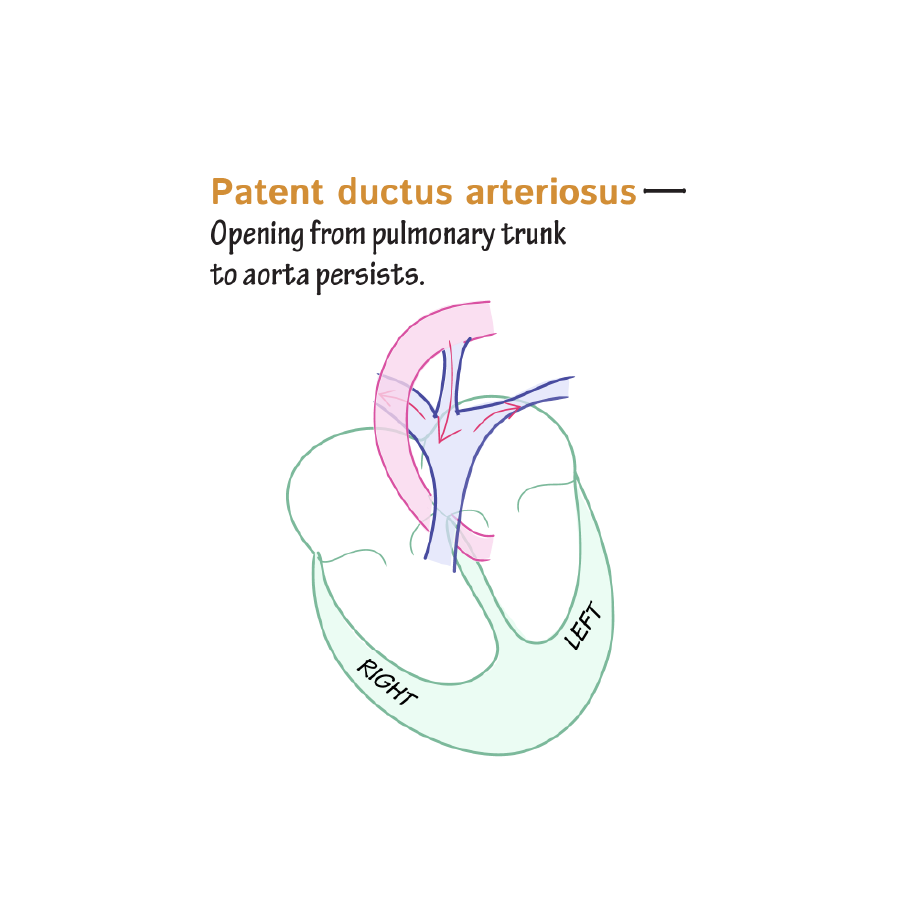
During development, the ductus arteriosus shunts blood from the pulmonary trunk to the aorta, bypassing the lungs; after birth, the ductus arteriosus closes and remains as the ligamentum arteriosum.
In a condition called patent ductus arteriosus, the shunt persists, allowing left to right blood shunting. The size of the opening determines the clinical severity of the shunt.
 The truncus arteriosus contributes to the pulmonary trunk.
By week 8, major remodeling approximates the adult form.
The ascending aorta is derived from the truncus arteriosus.
The arch of the aorta is derived mainly from the aortic sac and the left 4th aortic arch, while the descending aorta is derived from the left dorsal aorta.
The brachiocephalic artery is derived from the aortic sac.
The common carotid arteries are derived from the 3rd aortic arches, and the external carotid arteries arise as sprouts from the 3rd arches.
The proximal portions of the internal carotid arteries derive from the 3rd aortic arches, while the distal portions derive from the dorsal aortae.
The right subclavian artery is derived from the right 4th aortic arch, right dorsal aorta, and right 7th intersegmental artery.
The left subclavian artery is derived from the left 7th intersegmental artery and not from the aortic arches.
The pulmonary arteries and ductus arteriosus derive from the 6th aortic arches. Specifically, the left distal 6th arch forms the ductus arteriosus.
Lastly, the pulmonary trunk is derived from the truncus arteriosus.
In summary: by the 8th week we see a single aorta with its characteristic arch and three major branches.
Because of the asymmetrical growth of the aortic arches, the final location of the right and left recurrent laryngeal nerves is also asymmetrical:
The left recurrent laryngeal nerve branches from the vagus nerve and loops under the aortic arch, and the right recurrent laryngeal nerve wraps under the right subclavian artery.
The truncus arteriosus contributes to the pulmonary trunk.
By week 8, major remodeling approximates the adult form.
The ascending aorta is derived from the truncus arteriosus.
The arch of the aorta is derived mainly from the aortic sac and the left 4th aortic arch, while the descending aorta is derived from the left dorsal aorta.
The brachiocephalic artery is derived from the aortic sac.
The common carotid arteries are derived from the 3rd aortic arches, and the external carotid arteries arise as sprouts from the 3rd arches.
The proximal portions of the internal carotid arteries derive from the 3rd aortic arches, while the distal portions derive from the dorsal aortae.
The right subclavian artery is derived from the right 4th aortic arch, right dorsal aorta, and right 7th intersegmental artery.
The left subclavian artery is derived from the left 7th intersegmental artery and not from the aortic arches.
The pulmonary arteries and ductus arteriosus derive from the 6th aortic arches. Specifically, the left distal 6th arch forms the ductus arteriosus.
Lastly, the pulmonary trunk is derived from the truncus arteriosus.
In summary: by the 8th week we see a single aorta with its characteristic arch and three major branches.
Because of the asymmetrical growth of the aortic arches, the final location of the right and left recurrent laryngeal nerves is also asymmetrical:
The left recurrent laryngeal nerve branches from the vagus nerve and loops under the aortic arch, and the right recurrent laryngeal nerve wraps under the right subclavian artery.
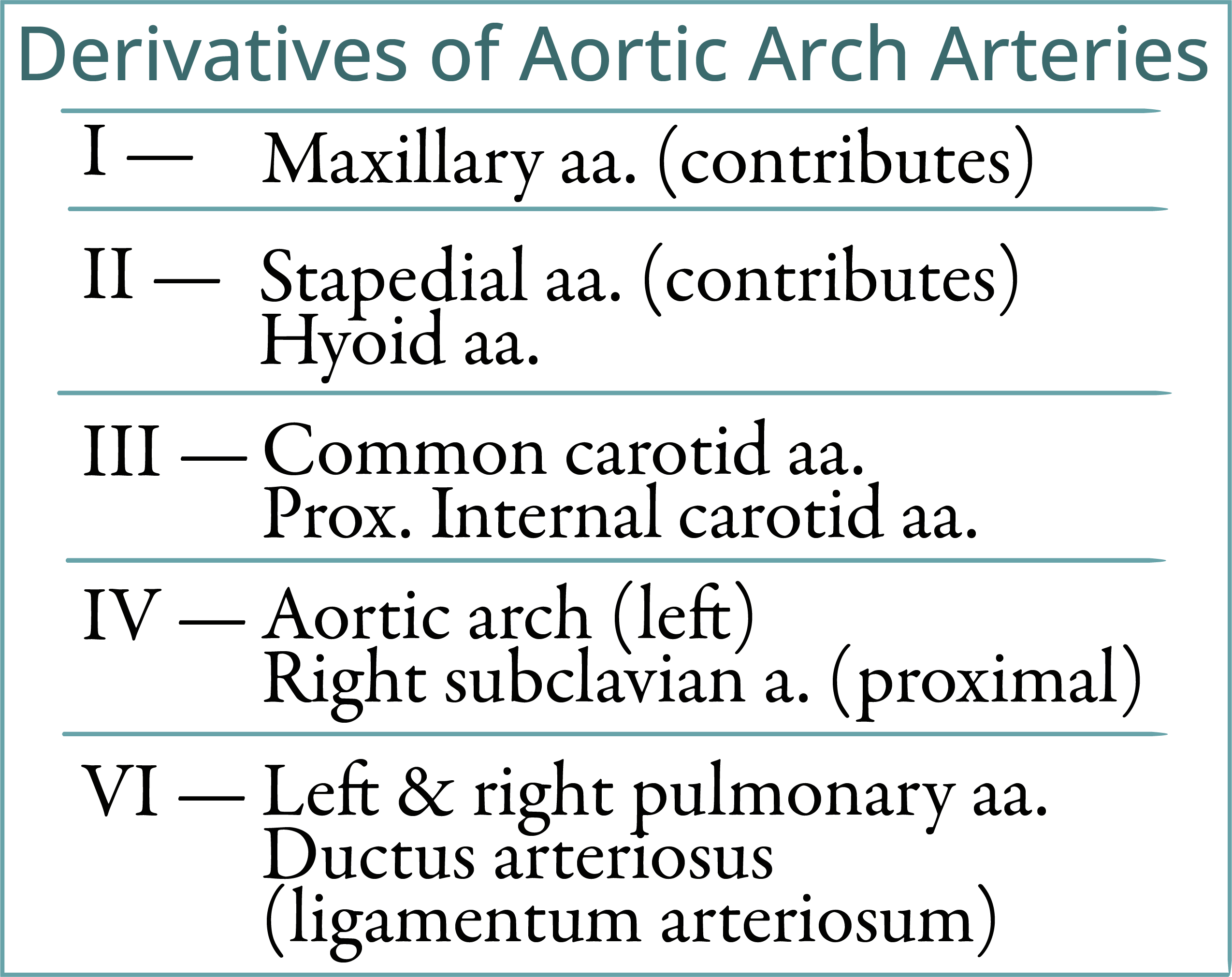 Remnants of the first aortic arches contribute to the maxillary arteries of the face.
Remnants of the second aortic arches contribute to the stapedial and hyoid arteries.
The third aortic arches, as we indicated in our diagrams, give rise to the common carotid arteries and proximal portions of the internal carotid arteries;
The left fourth aortic arch gives rise to a portion of the adult aortic arch; the right fourth aortic arch gives rise to the proximal portion of the right subclavian artery.
Finally, the sixth aortic arch gives rise to the pulmonary arteries and ductus arteriosus.
Remnants of the first aortic arches contribute to the maxillary arteries of the face.
Remnants of the second aortic arches contribute to the stapedial and hyoid arteries.
The third aortic arches, as we indicated in our diagrams, give rise to the common carotid arteries and proximal portions of the internal carotid arteries;
The left fourth aortic arch gives rise to a portion of the adult aortic arch; the right fourth aortic arch gives rise to the proximal portion of the right subclavian artery.
Finally, the sixth aortic arch gives rise to the pulmonary arteries and ductus arteriosus.
Week 5
Week 7
The truncus arteriosus contributes to the pulmonary trunk.
Week 8
Derivatives of the aortic arches 5
Remnants of the first aortic arches contribute to the maxillary arteries of the face.
Remnants of the second aortic arches contribute to the stapedial and hyoid arteries.
The third aortic arches, as we indicated in our diagrams, give rise to the common carotid arteries and proximal portions of the internal carotid arteries;
The left fourth aortic arch gives rise to a portion of the adult aortic arch; the right fourth aortic arch gives rise to the proximal portion of the right subclavian artery.
Finally, the sixth aortic arch gives rise to the pulmonary arteries and ductus arteriosus.