
Start your One-Week Free Trial
Already subscribed? Log in »
Shoulder Dislocation (aka Glenohumeral Dislocation)
Shoulder dislocation is the most common type of joint dislocation (50%).
Look for axillary nerve injury due to the proximity of the axillary nerve to the shoulder joint.
Anterior Dislocation
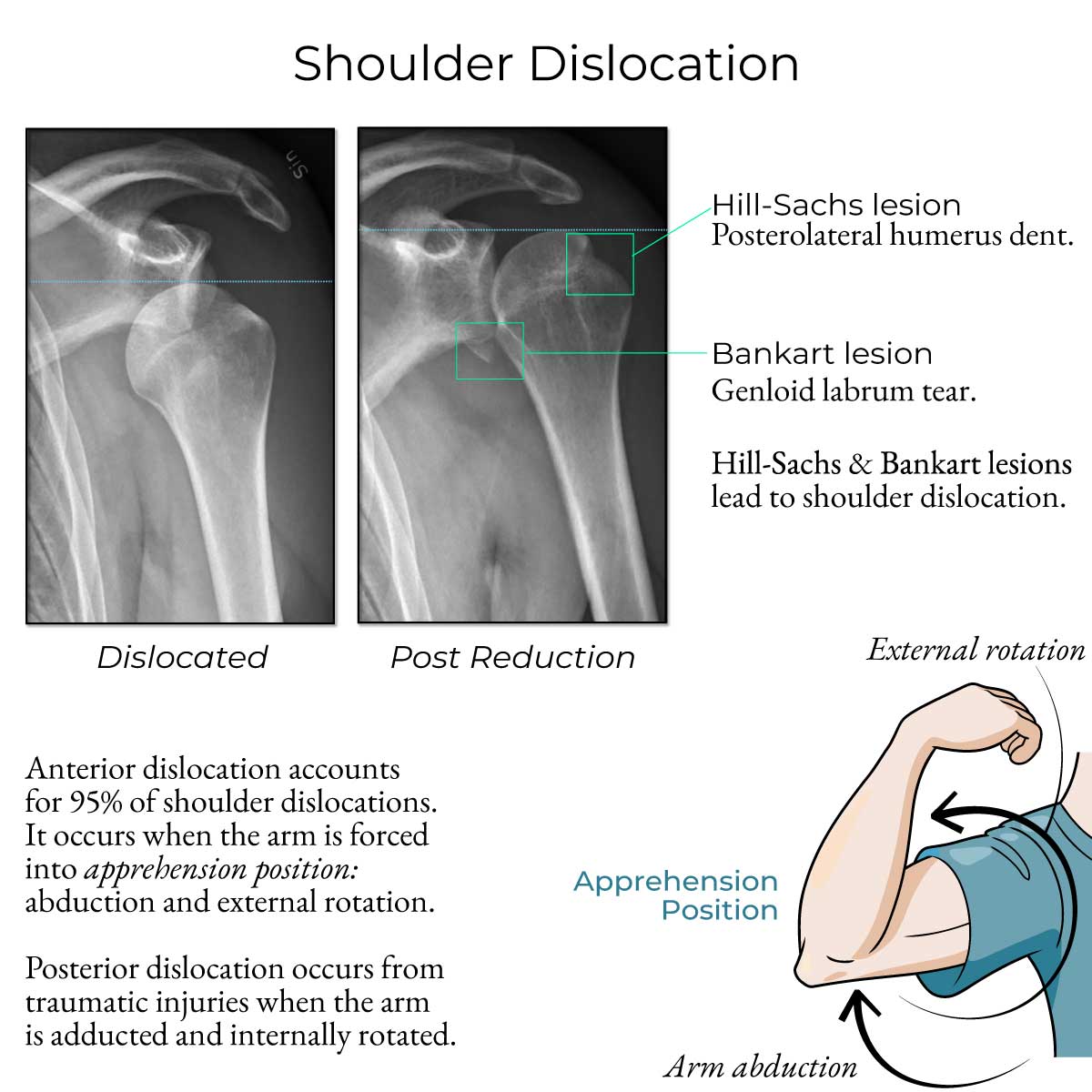
Anterior (forward) dislocation accounts for nearly all shoulder dislocations (95%).
The general mechanism is the arm is suddenly forced into the apprehension position: abduction and external rotation.
- Watch this video for a brief review of the Apprehension Test on physical exam.
- Hill-Sachs lesion: a posterolateral humerus head compression injury (a dent in the head of the humerus).
- Bankart lesion: a glenoid labrum tear.
- Note that a Bankart lesion is one form of SLAP lesion, which stands for "superior labrum anterior and posterior". SLAP tears involve injury of the biceps anchor (the origin of the long head of the biceps brachii) and the superior capsulolabrum.
Posterior Dislocation
Posterior dislocation occurs in traumas when the arm is adducted and slightly internally rotated: during tonic-clonic seizures, electrocution, and certain types of falls.
References
X-Ray Images: Shoulder Dislocation
Related Tutorials
NovoLearn Interactive Exercises
- Elbow Joint
- Carpal Tunnel & Guyon Canal Syndromes
- Epicondylitis & Cubital Tunnel Syndrome
- Glenohumeral Muscles
- Shoulder Muscles (Posterior)
- Glenohumeral Muscles
- Rotator Cuff Injury & Shoulder Dislocation
- De Quervain Tenosynovitis & Dupuytren Contracture
- Rotator Cuff Anatomy
- Rotator Cuff Injury & Shoulder Dislocation