
Start your One-Week Free Trial
Already subscribed? Log in »
Cubital Tunnel Syndrome
Pathology
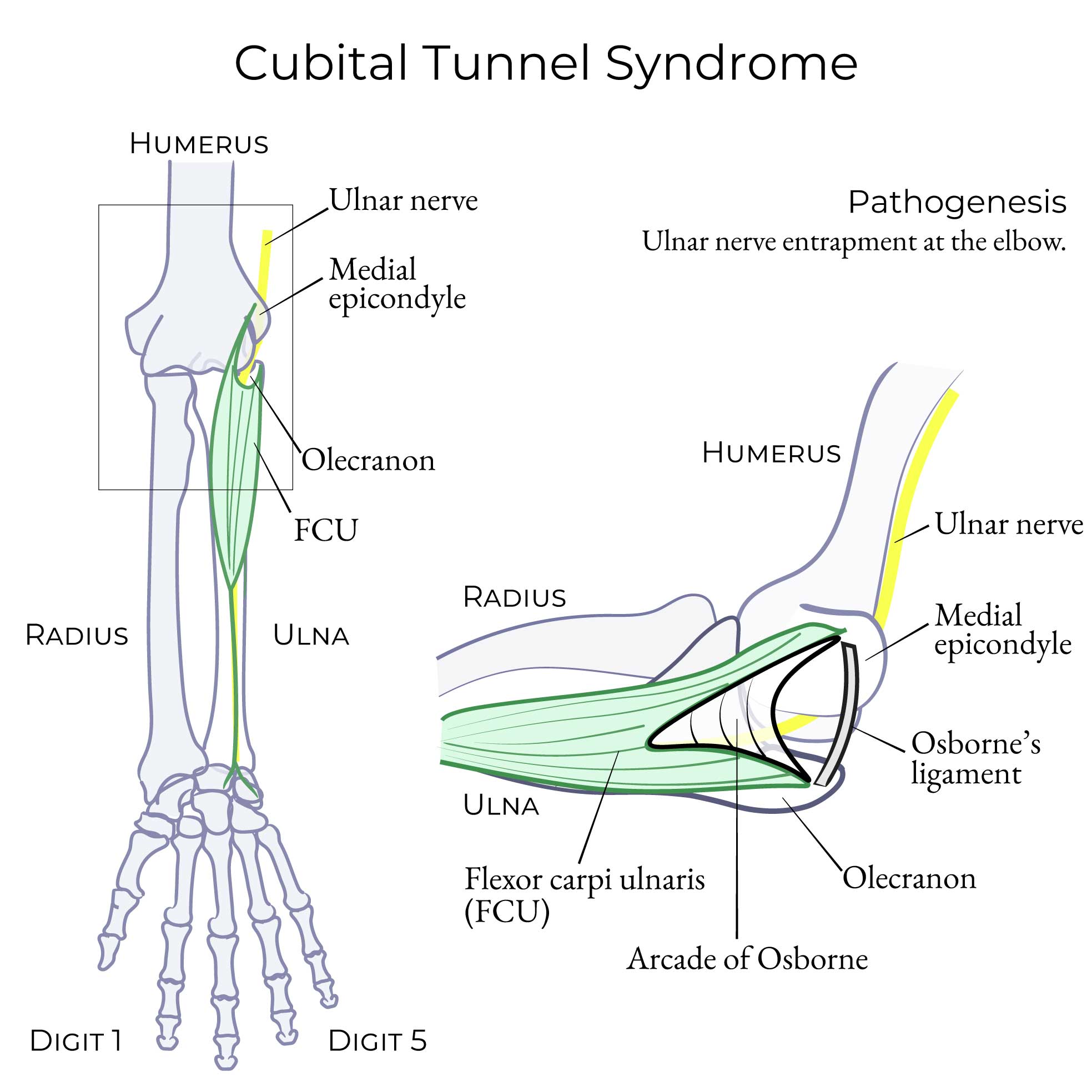
Ulnar nerve entrapment at the medial aspect of the elbow in the cubital tunnel.
Risk factors include excessive elbow flexion (eg, from pulling maneuvers) and direct compression from leaning on the elbow (the ulnar nerve is very superficial at the elbow). If you feel your medial epicondyle and flex/extend your arm, you may be able to feel your ulnar nerve pop in and out of the groove.
Anatomy
The cubital tunnel is formed from the medial epicondyle (superiorly), olecranon (inferiorly), and Osborne's ligament (roof).
Note that Osborne's ligament is differentiated from the Arcade of Osborne, which connects the heads of flexor carpi ulnaris. Also note that there is considerable intertextual variation in the nomenclature regarding Osborne's ligament.
Symptoms
Cubital tunnel syndrome causes compression of the ulnar nerve proximal to the takeoff of the ulnar-innervated muscles, so it can impact the muscle power and bulk of the medial forearm muscles and the ulnar hand muscles. As well, it can cause numbness/tingling or loss of sensation in the ulnar-innervated digits (4th and 5th digits).
Given its anatomical distribution, cubital tunnel syndrome can co-occur with medial epicondylitis.
Diagnosis
The most definitive objective indication of cubital tunnel syndrome is slowing of nerve conduction velocity through the cubital tunnel.
- A relative drop in conduction velocity from the upper arm into the forearm of at least 10 m/s can be observed or an absolute reduction of forearm nerve velocity to below 50 m/s can be observed.
Treatment
- Avoidance of elbow flexion
- Rest, Ice, & Anti-inflammatories.
- Surgical "release" (decompression) can be performed.