
Start your One-Week Free Trial
Already subscribed? Log in »

Ankle Sprain
Overview
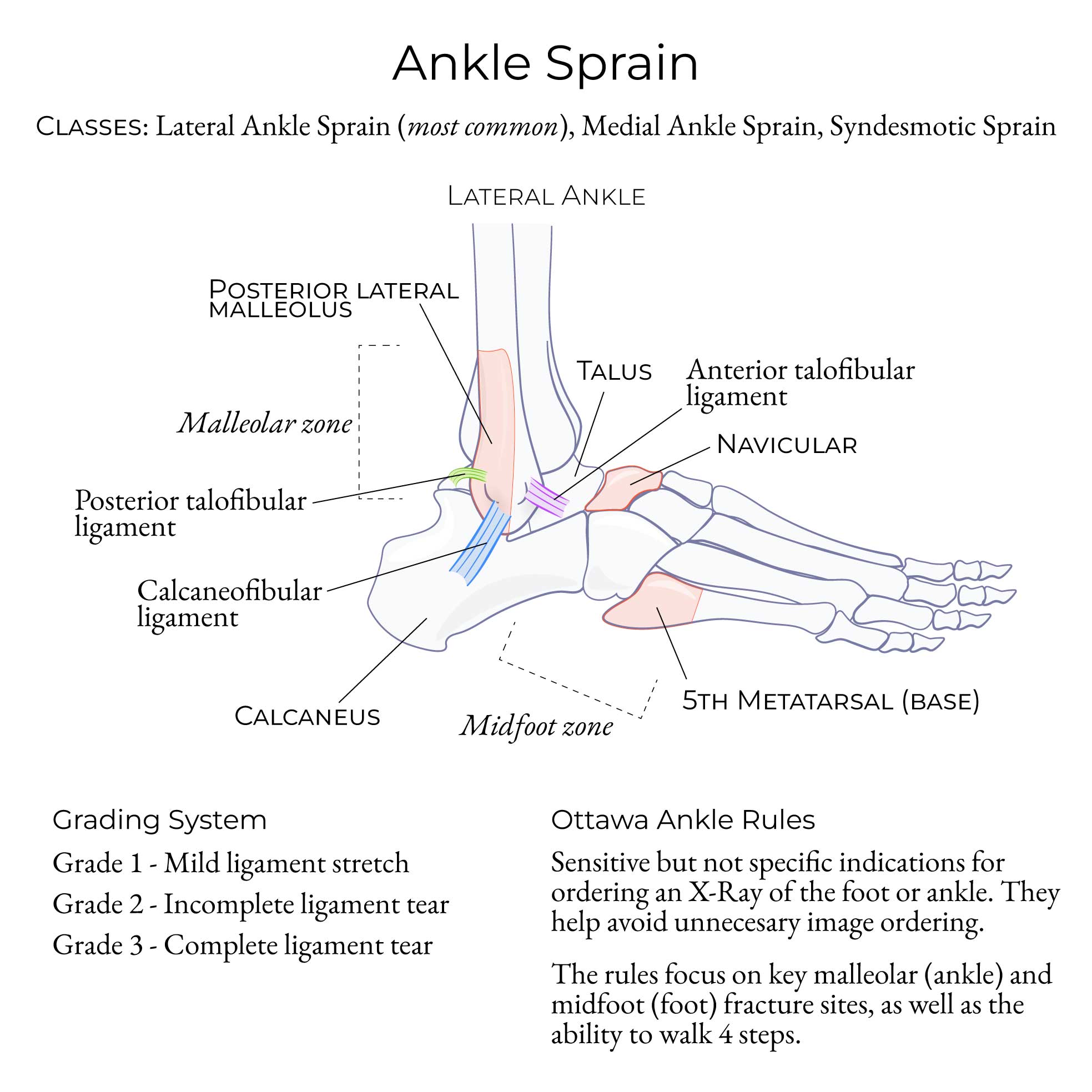
Ankle sprains are one of the most common orthopedic injuries. They typically involve the lateral ankle ligaments and are generally caused from over-inversion of the foot, while the foot is in plantar flexion. The focus of this brief summary will be on lateral ankle sprain.
Additional types of ankle sprain include:
- Medial ankle sprain involves the medial deltoid ligament (a complex of ligaments on the medial aspect of the ankle). The deltoid ligament is rarely injured in isolation, typically with a high ankle sprain (discussed next). We might assume that forced eversion would cause medial ankle ligament injury (because forced inversion causes lateral ankle ligament injury). However, the deltoid ligament is so powerful that forced eversion ends up causing an avulsion fracture of the medial malleolus of the fibula, instead.
- Syndesmotic sprain (aka high ankle sprain) involves injury to multiple ligaments critical for ankle stability. A syndesmosis is a fibrous joint that comprises a complex of ligaments and membranes that connect adjacent bones. It occurs from excessive foot dorsiflexion and external rotation (as opposed to plantarflexion and inversion (lateral ankle sprain). In a syndesmotic sprain, the lateral and medial ankle ligaments as well as other fibrous connective tissues are damaged.
Pathophysiology
When the foot is plantar flexed (toes down/heel up), hyper-inversion (rolling) of the foot can injure the lateral ankle ligaments. The anterior talofibular ligament is the most frequently injured.
Key Anatomy
Lateral Ankle
Key bones: Fibula (lateral malleolus); Talus, Calcaneus
Key ligaments: Anterior talofibular ligament, Calcaneofibular ligament, and Posterior talofibular ligament
Medial Ankle
Key ligament complex: Deltoid ligament complex.
Grading System
- Grade 1 - Mild ligament stretching with mild swelling and tenderness. No ligament laxity or joint instability.
- Grade 2 - Incomplete tear of a ligament (typically the anterior talofibular ligament). Associated with moderate pain, swelling, bruising (ecchymosis) and joint instability with difficulty with ambulation and range of motion.
- Grade 3 - Complete ligament tear. Severe pain, swelling, and bruising (ecchymosis). Significant joint instability and often unable to bear weight/ambulate.
Ottawa Ankle Rules
The purpose of these rules are to reduce unnecessary ankle or foot X-Ray imaging. They are 100% sensitive but only ~ 35% specific (meaning these rules should avoid missing a fracture but do not reliably diagnose a fracture).
Ankle X-Ray is necessary if there is 1) malleolar zone pain plus EITHER 2) tenderness over potential fracture areas: posterior lateral or medial malleolus OR 3) Inability to bear weight for 4 steps immediately after injury or upon evaluation.
Foot X-Ray is necessary if there is 1) midfoot zone pain plus EITHER 2) tenderness over potential fracture areas: base of the 5th metatarsal or navicular bone OR 3) Inability to bear weight for 4 steps immediately after injury or upon evaluation.
See Ottawa Ankle Rules from the journal American Family Physician.